 How-to
How Tight Should a Table Tennis Net Be for Tournaments?
Last Updated: October 29, 2026
Quick Summary
To maintain proper net tension for tournaments, loosen both clamps fully, hook the cord side first, pull until the net is flat, then tension the opposite post until the center height matches the post height. Lock both clamps snug and re-measure at both posts and the center with a gauge.
- The net must sit 15.25 cm high across its full length, including at the center.
- Press-test the center with one finger: it should give slightly, then spring back flat.
- Tension the net in the room where you will play, let it settle ten minutes, then re-measure.
- Re-check all three height readings after five minutes of play to catch settling.
- Replace a slipping clamp with worn pads or threads rather than tightening it further.
Table of Contents
- Why Net Tension Decides Fair Play at Tournaments
- Table Tennis Net Height Measurement: The Numbers That Matter
- Table Tennis Net Clamp Adjustment for Even Tension
- Table Tennis Net Sagging Fix: A Repeatable Setup Routine
- How Tension Affects Power, Control, and Spin
- Environmental and Venue Effects on Net Tension
- Tournament Table Tennis Equipment Checklist
- Get Tournament-Ready: Check Your Net, Then Speed Up Cleanup
- Frequently Asked Questions
Why Net Tension Decides Fair Play at Tournaments
A table tennis net that sags in the middle changes the game. The ball clips the cord on a low serve.
Learning how to maintain proper net tension for tournaments can help address that problem.
Net tension and net height are two separate jobs, and you need both right. A tight net set too high is still illegal. A net at the correct height but loose plays nothing like a tournament table.
Net tension is the firmness of the net cord across the full width of the table.
The official rules set a hard boundary here. The ITTF Statutes and Regulations define the net assembly, its height, and how it must be attached.
Table Tennis Net Height Measurement: The Numbers That Matter
The net must sit 15.25 cm high across its full length, with the top of the net at exactly 15.25 cm at the center. The net assembly extends 15.25 cm beyond each side of the table.
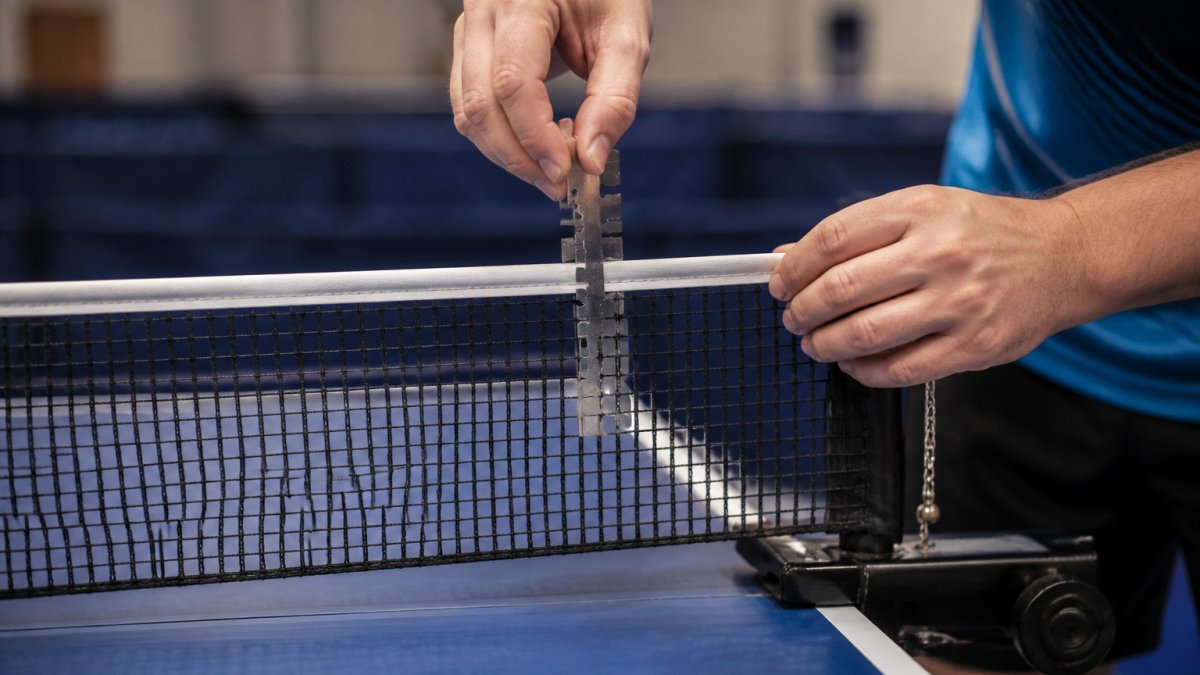
Those numbers are not suggestions. A net that measures right at the posts but dips at the center is out of spec, and a referee can call it before a match.
Here is the measurement process we recommend:
- Set the table on level ground and check the surface with a spirit level.
- Place a measuring gauge at each net post and read the height.
- Move the gauge to the center of the net and read again.
- Compare the three readings. They should match.
- Adjust the clamps and cord until all three agree.
Using a Tension Gauge and Measuring Gauge
A measuring gauge handles height. A tension gauge handles firmness. The two tools do different jobs, and most players own neither.
For height, a simple L-shaped gauge or a marked card works.
For tension, the net should feel firm but not drum-tight. Press the center with one finger: it should give slightly, then spring back flat.
Watch out: Over-tightening stretches the net fabric, bends the clamp threads, and can pull the post bracket loose mid-event.
Table Tennis Net Clamp Adjustment for Even Tension
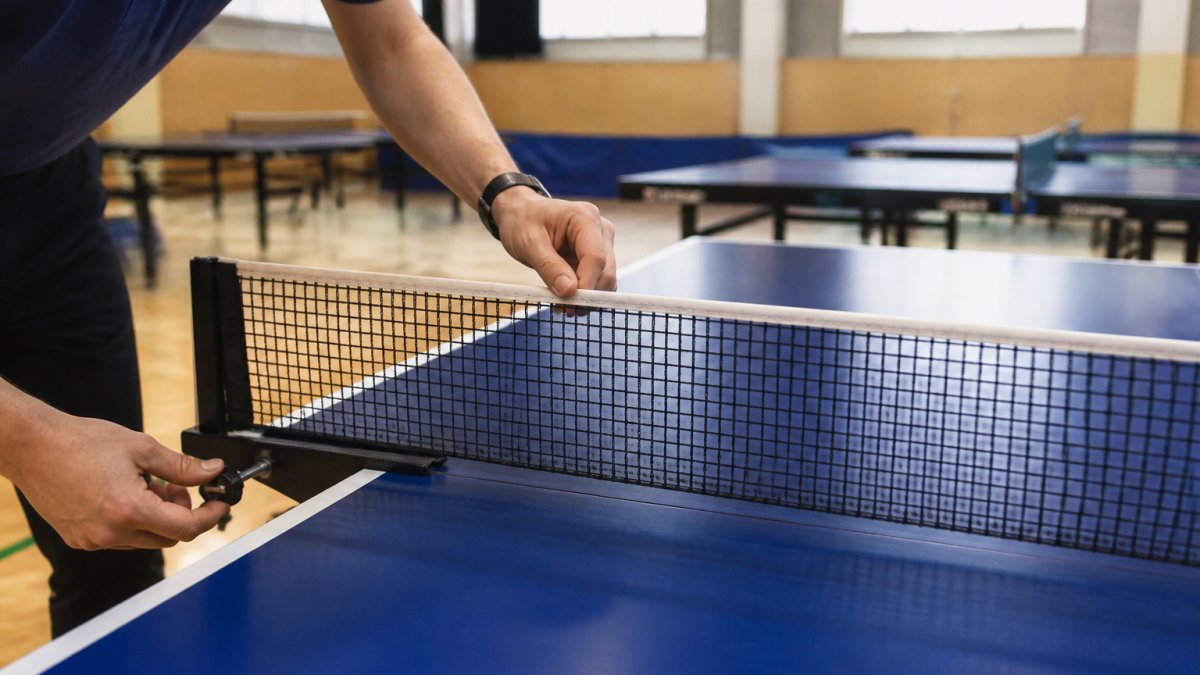
Uneven tension can be a net problem. One clamp grips hard, the other slips, and the center height drifts as soon as the first ball hits the cord.
The fix is not more force. It is a sequence that tensions both sides evenly and verifies the result with a measurement, not a feel:
- Loosen both clamps fully before you start so the net hangs slack.
- Hook the net to the post on the side with the tension cord first.
- Pull the cord until the net is flat across the table, then lock that clamp.
- Move to the opposite post and pull until the center height matches the post height.
- Lock the second clamp and re-check the center with a gauge.
The clamp screw should be snug, not forced. If a clamp keeps slipping, the threads or the pad are worn, and no amount of tightening will fix it. Replace the clamp before the event, not during it.
Why Even Tension Is a Rules Issue, Not Just a Feel Issue
The height requirement applies across the full length of the net, not just at the posts, so a net that measures correctly at both posts but dips at the center is out of spec.
Tournament players often tension by ear or by feel, then discover at the table that the center sits low. The reliable method is to tension, measure, adjust, and measure again. Two passes usually settle it.
Sport-Specific Notes: Tennis, Badminton, and Table Tennis
The keyword asks about net tension, and the same principles apply across net sports, but the standards differ. In table tennis, the net height and overhang are set by the ITTF Statutes and Regulations, and the net assembly must be attached so the top of the net is at the required height along its full length. Tennis and badminton have their own governing-body specifications for net height at the center and at the posts, and their own hardware for tensioning.
Troubleshooting Slipping and Over-Tightened Clamps
- Clamp slips under load: the pad or threads are worn. Replace the clamp; do not add tape or shims as a match-day fix.
- Cord will not hold tension: the cord has stretched or the tensioner has failed. Swap in a spare cord set before the event.
- Net feels drum-tight: you have over-tightened. Back off in small steps and re-measure.
- One side tighter than the other: loosen both clamps and restart the sequence.
Once the clamps are set and measured, the next job is keeping that setup stable through a full event. The routine below covers the rechecks that catch settling before it costs you a match.
Table Tennis Net Sagging Fix: A Repeatable Setup Routine
Sag comes from three places: a stretched cord, a slipping clamp, or a net that was never tensioned evenly. For the broader equipment maintenance routine that keeps your net and table in tournament condition, see the full guide. A fixed routine catches all three before they cost you a match.
Run this sequence every time you set up:
- Lay the net flat and check for creases or folds
- Attach both clamps loosely to the posts
- Tension the cord side first, then the opposite side
- Measure height at both posts
- Measure height at the center
- Press-test the center for firmness
- Re-check all three height readings after five minutes of play
That last step matters. New nets and cold gyms both cause the cord to settle after the first few rallies.
How Tension Affects Power, Control, and Spin
A tight net gives you a predictable bounce and a clean cord response. A loose net swallows energy and turns clean shots into lucky ones.
The ball brushes the top cord on low shots. If the cord is firm, the ball deflects in a consistent direction.
Tension also shapes how much you trust your shots:
- Power: a firm net lets you hit through the ball without fear of the cord grabbing it.
- Control: a flat, even net gives you the same response on both sides of the table.
- Spin: heavy topspin needs a consistent net height to clear safely, especially on fast loops.
The net will not add power to your game. It removes the random misses that make you hold back.
Environmental and Venue Effects on Net Tension
Temperature and humidity move net tension more than most players expect. A net tensioned in a cold storage room and set up in a warm gym will loosen within the hour. A net tensioned warm and moved to a cold hall can pull tighter than you set it.
Watch for these venue effects:
- Heat: cord and net fabric expand, and the center sags.
- Cold: materials contract, and the net can pull tighter than you set it.
- Humidity: fabric absorbs moisture and stretches.
- Drafty halls: airflow near open doors shifts temperature fast.
- Direct sun through windows: one side warms faster than the other, producing uneven tension across the table.
The practical fix is a timing routine, not a one-time adjustment. Club organizers can find club equipment maintenance tips for dealing with venue conditions.
A Pre-Match Inspection Checklist for Tournament Play
Use the same sequence before every match so nothing depends on memory:
- Confirm the table is on level ground and the surface is level.
- Measure net height at both posts with a gauge.
- Measure net height at the center with the same gauge.
- Confirm the net overhang beyond each side of the table.
- Press-test the center for firmness and check for uneven sag.
- Check clamps for slipping and cord for fraying or stretch.
- Re-measure after ten minutes in the playing room.
- Re-check after the first five minutes of play.
That last step matters. New nets and cold gyms both cause the cord to settle after the first few rallies. A quick re-check catches it before a referee does.
Measurement Accuracy and Tool Calibration
A gauge is only useful if it reads consistently. Use the same gauge for the posts and the center, and check it against a known reference before the event. A simple L-shaped gauge or a marked card works for height; slide it under the cord at each point and confirm the cord touches the top of the gauge. For tension, press the center with one finger: it should give slightly, then spring back flat.
Safety and Common Failure Modes
- Uneven sag: usually a slipping clamp or a cord tensioned from one side only. Loosen both clamps and restart the tension sequence.
- Slipping hardware: worn clamp pads or threads. Replace the clamp; do not improvise a fix at the table.
- Damaged cord: fraying or a snapped cord is a replacement job, not a repair job. Carry a spare cord set.
- Over-tightening: stretches the net fabric, bends clamp threads, and can pull the post bracket loose. Tighten in small steps and re-measure.
For players, the takeaway is simpler: measure in the room you play in, recheck after settling, and carry spares for the parts most likely to fail.
Tournament Table Tennis Equipment Checklist
Pack for the net first, because it is the item most likely to fail and the hardest to improvise. See the full list of essential gear for competitive players beyond the net.
Use this checklist before any event:
| Item | Why It Matters | Check Before |
|---|---|---|
| Measuring gauge | Confirms net height at posts and center | Packing |
| Spare net and cord set | Replaces a stretched or snapped cord | Packing |
| Spare clamps | Fixes slipping or stripped clamps | Packing |
| Small screwdriver | Tightens clamp screws and post brackets | Packing |
| Tape measure | Checks net overhang beyond the table | Setup |
| Clean cloth | Removes dust and moisture from the cord | Setup |
| Spare balls | Keeps warm-up and matches running | Packing |
Get Tournament-Ready: Check Your Net, Then Speed Up Cleanup
A correct net is half the job. Learn how to prevent equipment damage during storage so your gear stays protected between events. Tournament organizers can find simple ways to organize table tennis events and equipment efficiently.
Here is one cleanup challenge: after setting up, players and coaches may need to collect balls from the floor.
MyPingPongBuddy offers a handmade, portable ball-collection tool that breaks down in half for transport. It lets players scoop up balls without bending over.
A customer said, "This makes cleanup SO INCREDIBLY EASY and actually kind of fun!" The product is backed by a 90-day return policy with a full refund.
Get started with MyPingPongBuddy and make ball cleanup easier.
Frequently Asked Questions
How tight should a table tennis net be for a tournament?
The article describes checking net height at the posts and center and checking the cord for firmness. Consult the applicable tournament rules for net requirements.
How do you check table tennis net tension before a match?
The article describes checking net height at the center and posts, looking for sag, and checking cord firmness. Consult the applicable tournament rules for net requirements.
Can net tension affect table tennis play?
The article states that net height and tension are separate considerations and describes checking the net at the posts and center. Consult the applicable tournament rules for net requirements.
What should I inspect on a table tennis net before a tournament?
The article's checklist includes checking net height at the posts and center, cord firmness, clamps, and cord condition. Consult the applicable tournament rules for net requirements.