 how-to
How Do You Prevent Table Tennis Equipment Damage During Storage?
Last Updated: October 24, 2026
Quick Summary
To prevent equipment damage storage, keep your rackets, balls, and table in a cool, dry location between 50-70°F with 40-60% humidity, away from heat, sunlight, and moisture. Store rackets in individual protective covers, balls in rigid containers, and use silica gel packets to absorb excess moisture in your storage space.
- Store equipment at 50-70°F with 40-60% relative humidity to protect rubber, wood, and plastic from degradation.
- Always clean and completely dry rackets before storage to prevent mold and rubber hardening.
- Use individual protective covers for rackets and rigid bins for balls to prevent compression damage and contamination.
- Monitor storage spaces every 2-3 months and replace or recharge silica gel packets to control humidity.
- Never store equipment in hot vehicles, near heat sources, or in direct sunlight, as temperatures above 75°F damage rubber and plastic.
Table of Contents
- Why Proper Storage Prevents Table Tennis Equipment Damage During Storage
- How to Store Table Tennis Rackets Safely
- Table Tennis Rubber Storage: Protecting Your Playing Surface
- Table Tennis Ball Storage: Maintaining Bounce and Condition
- Creating Optimal Storage Conditions for All Equipment
- Table Tennis Equipment Storage Ideas for Limited Space
- Common Storage Mistakes That Damage Equipment
- Preparing Your Equipment for Long-Term Storage
- Frequently Asked Questions
Why Proper Storage Prevents Table Tennis Equipment Damage During Storage
Storing table tennis equipment the wrong way costs money: rackets warp, rubber hardens, and balls lose their bounce, often silently, until you find your gear no longer game-ready.
Preventing table tennis equipment damage during storage is straightforward once you understand the culprits: heat, moisture, dust, and sunlight.
This MyPingPongBuddy guide covers protecting your rackets, balls, and table, whether for the off-season or between sessions.
How to Store Table Tennis Rackets Safely
Your racket is your most valuable equipment; proper storage protects the blade and the vulnerable rubber surface.
Clean and dry your racket before storage
Always start with a clean racket, dirt and dust trap moisture against the rubber.
Here's how to clean your racket:
- Wipe the rubber surface with a damp cloth or soft chamois
- Use gentle, circular motions to remove dust and dirt
- Avoid harsh scrubbing that damages the rubber
Never store a damp racket; let it air dry completely to prevent mold and rubber degradation.
Use a protective racket cover or case
A racket cover or case is non-negotiable, shielding equipment from dust, heat, and impact.
Quality covers come in two main types:
- Soft covers: Lightweight, affordable, and easy to transport. Best for short-term storage and travel.
- Hard cases: Rigid protection that guards against impacts. Better for long-term storage and frequent movement.
Choose moisture-resistant covers that fit snugly without compressing the rubber, and use individual covers so rackets don't rub together.
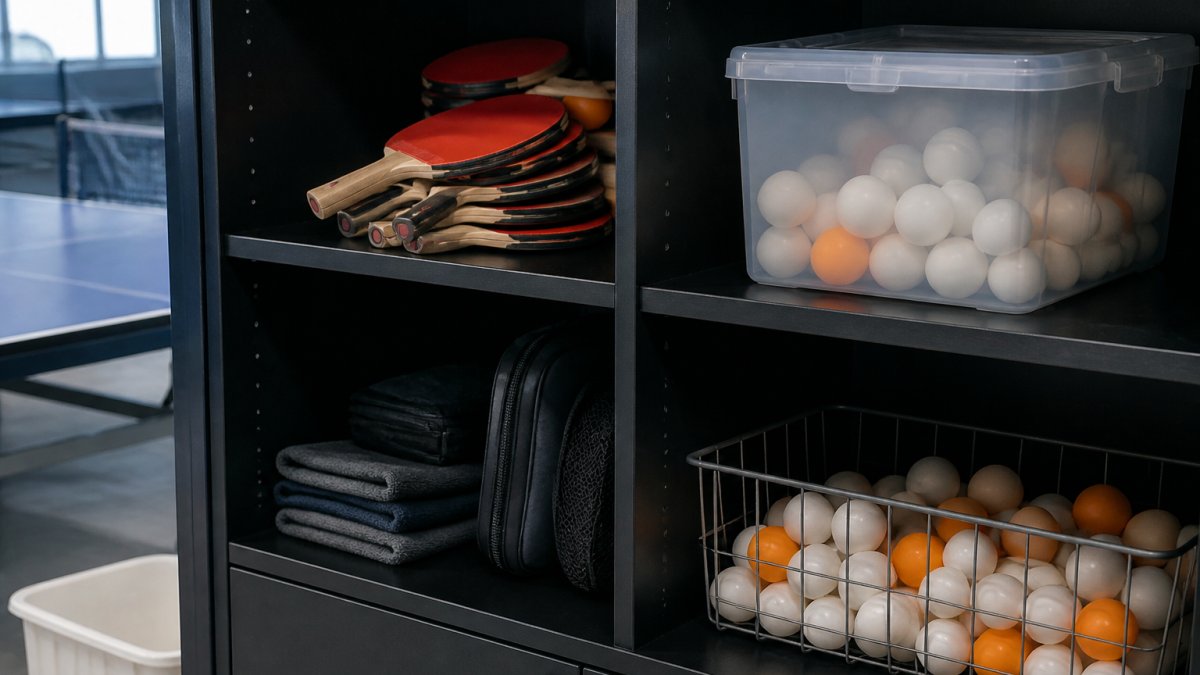
For coaches and facility managers with dozens of rackets, a practical alternative is airtight plastic bins with silica gel packets inside, protecting multiple rackets in one compact space.
Table Tennis Rubber Storage: Protecting Your Playing Surface
Rubber is the most delicate part of your racket, hardening and losing grip when exposed to heat, sunlight, and dry air.
Keep rubber away from heat and sunlight
Heat is rubber's worst enemy: prolonged warmth hardens it and kills elasticity, while UV exposure accelerates the damage.
Avoid storing your racket in these locations:
- Near windows with direct sunlight
- In hot vehicles or garages during summer
- Above heating vents or radiators
Even moderate heat above 75°F slowly degrades rubber, so move equipment somewhere cooler if your storage space gets warm.
Store rubber in a cool, dry location
Target storage conditions:
- Temperature: 50-70°F (ideal range for rubber preservation)
- Humidity: 40-60% relative humidity
- Darkness: Away from direct light sources
A climate-controlled closet, basement, or interior room works well. Avoid damp spaces like bathrooms or uninsulated sheds: high humidity promotes mold and rust, while low humidity dries out rubber and wood.
In humid climates, use silica gel packets or a small dehumidifier to absorb excess moisture and protect your equipment.
Table Tennis Ball Storage: Maintaining Bounce and Condition
Balls are the cheapest part of a table tennis setup and the easiest to ruin in storage. A ball that has lost its bounce or gone out of round will not recover, so prevention matters more than repair.
What actually damages stored balls
Three mechanisms account for most ball damage:
- Heat deformation. Most balls today are ABS plastic, which softens at moderately elevated temperatures. A car parked in summer sun can exceed 140°F inside, well past the point where stored balls begin to lose roundness permanently.
- Sustained compression. Balls stored under weight, crammed into a full bag, or left under a table leg develop flat spots. The plastic takes a set, and the ball will wobble or bounce unpredictably even after the pressure is removed.
- Surface contamination and UV exposure. Oils, dust, and prolonged sunlight degrade the plastic surface, yellow white balls, and fade printed star ratings used to sort practice stock from match stock.
Practical storage conditions for balls
Balls tolerate a wider range than rubber, but the same environment protects both:
- Temperature: 50-70°F, stable. Brief excursions are fine; repeated cycling is not.
- Humidity: 40-60% relative humidity. Very dry air does not harm ABS balls much, but very humid air encourages mold on the cardboard packaging and on cloth ball bags.
- Light: dark storage. Keep balls out of direct sun and away from display shelves under bright lamps.
Containers and organization that work
- Original packaging is fine for new match balls, since the box prevents rolling and compression. Keep it off the floor and out of sunlight.
- Rigid plastic bins with a lid are best for bulk practice stock. Choose one deep enough for a single or double layer, not a tall bin where the bottom layer bears the weight above it.
- Mesh or cloth ball bags are convenient for transport but poor for long-term storage, they offer no compression protection and absorb humidity. Empty them into a bin when you get home.
Sorting and rotating your stock
Balls degrade gradually, so fresh and two-year-old stock look alike until you play. A simple rotation system prevents mid-match surprises:
- Label bins by date. Write the month and year the balls went into storage on a strip of tape on the lid.
- Separate match stock from practice stock. Keep competition balls in their original sealed boxes until you need them. Once a box is opened, those balls become practice stock.
- Retire balls on a schedule, not on feel. Clubs commonly retire practice balls after a few months of regular play and inspect stored stock every six months; home players should inspect once a year and discard any ball that is out of round, cracked, or discolored.
- Test before you trust. Drop a ball from about 12 inches onto a hard, level surface. A good ball rebounds cleanly to roughly two-thirds of its drop height; one that bounces low, wobbles, or sounds dull belongs in the practice bin.
A note for clubs and facilities
Facilities buying balls in bulk should keep stock in sealed bins a few inches off the floor, away from sweating walls and heat sources, rotating the oldest labeled bin first. Without climate control, a small dehumidifier and a thermometer-hygrometer combo keep conditions safe.
Creating Optimal Storage Conditions for All Equipment
Your entire table tennis setup needs a consistent environment to prevent equipment damage storage and stay in good condition.
Temperature and humidity guidelines
Temperature swings damage equipment more than consistent cold or heat: rapid changes make wood expand and contract, warping the blade.
Optimal storage environment:
- Keep temperature stable between 50-70°F
- Maintain humidity between 40-60%
- Avoid rooms with extreme seasonal changes
If storage drops below 50°F, let equipment acclimate to room temperature before use, cold rubber becomes stiff and less responsive.
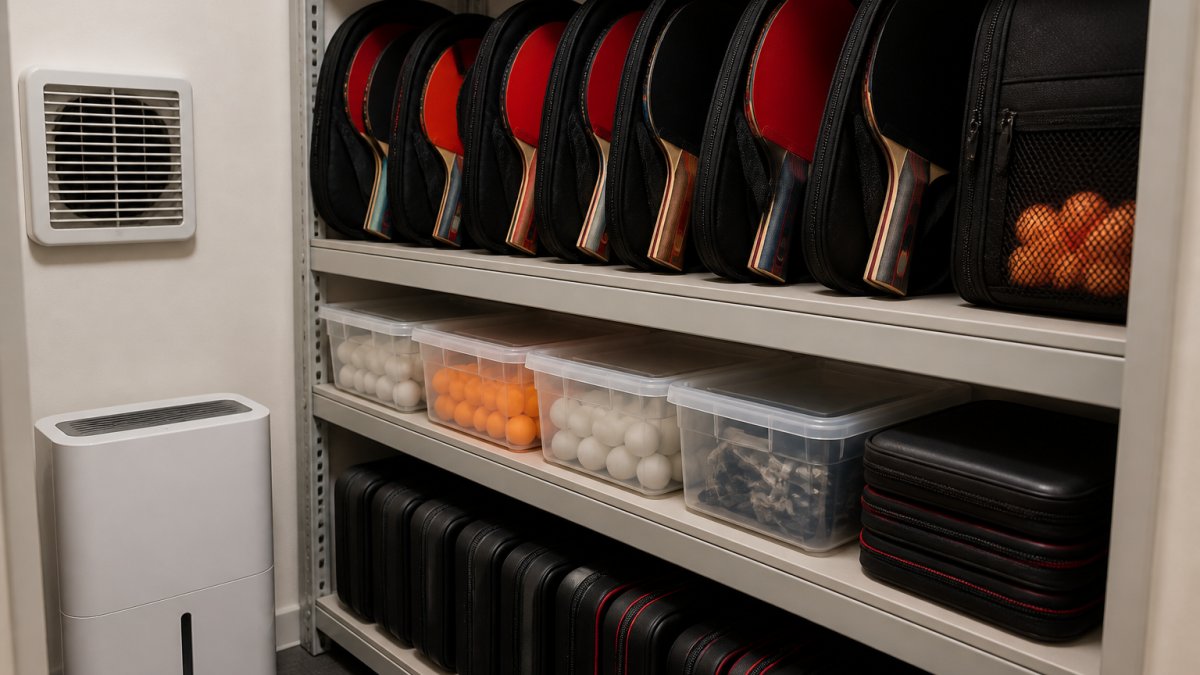
Storage location options: garages, basements, and sheds
Basements: Often the best choice, cool and dark, but watch for moisture.
Garages: Temperature swings are common, and summer heat spikes damage rubber. Insulate the storage area or use a climate-controlled cabinet.
Sheds: Typically the worst option, exposing equipment to extreme temperature changes and moisture.
Closets and interior rooms: Ideal if available, with stable temperature and humidity.
Using silica gel and moisture control
Silica gel packets are inexpensive insurance against humidity damage.
To recharge silica gel, bake packets at 250°F for 2-3 hours to drive out trapped moisture.
For larger spaces, a small dehumidifier pulls moisture from the air, especially useful in humid climates or damp basements.
Table Tennis Equipment Storage Ideas for Limited Space
Space constraints are real for many players and coaches; smart organization keeps equipment accessible and protected.
Vertical storage solutions:
- Wall-mounted racks for rackets and paddles
- Pegboards with hooks for covers and cases
- Tall shelving units to maximize height
Compact storage methods:
- Stack protective cases on shelves rather than spreading them across a room
- Use under-bed storage containers for balls and spare equipment
- Install a tension rod in a closet to hang multiple racket covers
The key is keeping equipment off the floor, away from moisture, and organized. See how to store table tennis training gear for more guidance on organizing your full setup.
For facility managers with dozens of tables and hundreds of balls, best table tennis paddle cases for travel offers specific product recommendations that work for both personal use and bulk storage.
Common Storage Mistakes That Damage Equipment
Most damage happens because of preventable mistakes.
Storing near heat sources: Radiators, vents, and direct sunlight are racket killers.
Using plastic bags instead of breathable covers: Plastic traps moisture and promotes mold.
Ignoring humidity: High humidity causes rust on metal parts and mold on rubber.
Overcrowding storage spaces: Cramped conditions prevent air circulation and trap moisture.
For a deeper look at why these mistakes happen and how to fix them, how to maintain table tennis equipment walks you through the broader context of equipment care.
These preventable mistakes account for most equipment damage during storage.
| Mistake | Primary Cause | Result |
|---|---|---|
| Storing wet or damp equipment | Moisture trapped in storage | Rubber degradation and mold growth |
| Leaving rackets in hot vehicles | Summer heat exceeds 140°F | Rubber destroyed in hours |
| Stacking rackets without covers | Rubber surfaces rub together | Friction damage and contamination |
| Storing near heat sources | Radiators, vents, direct sunlight | Racket damage |
| Using plastic bags instead of covers | Plastic traps moisture | Mold promotion |
| Ignoring humidity | High or low humidity extremes | Rust on metal parts or dried wood |
| Overcrowding storage spaces | Cramped conditions | Prevented air circulation and trapped moisture |
Preparing Your Equipment for Long-Term Storage
Long-term storage is where most preventable damage happens, because equipment sits unattended for months and small problems compound. This section adds a component-by-component checklist, a seasonal timeline, and a re-entry procedure so you can store equipment confidently and bring it back into play without surprises.
Component-by-component checklist before storage
Work through each item in order. Do not skip the drying steps; moisture trapped in a case or bin is the most common cause of long-term damage.
Rackets (blade and rubber)
- Clean the rubber with a damp cloth or soft chamois, then dry completely with a clean, dry cloth.
- Inspect the rubber for lifting edges, cracks, or shiny worn spots. Note any racket that needs re-gluing or replacement before next season.
- Check the blade for warping by sighting along the edge. A warped blade will not flatten out in storage.
Balls
- Sort into match stock (still sealed) and practice stock (opened).
- Discard any ball that is cracked, visibly out of round, or dull-sounding when dropped.
- Store in rigid bins labeled with the date, in a single or double layer, with nothing stacked on top.
Table (top, frame, and folding mechanism)
- Wipe the playing surface with a dry or barely damp cloth, then dry completely. Do not use household cleaners on the table surface; they can leave residue that attracts dust and, on some finishes, cause clouding.
- Clean dust and grit from the folding hinges and locking mechanisms. Grit left in a hinge for months accelerates wear and can make the table hard to fold.
- Apply a light coat of machine oil or silicone spray to hinge points if the manufacturer recommends it. Check your table's manual, because some mechanisms are designed to run dry.
Nets and posts
- Remove the net from the posts and wipe it dry. A damp net left attached to the table can rust the post clamps and stain the table edge.
- Store the net loosely rolled or folded, not stretched tight, to avoid permanent deformation of the mesh.
- Keep post clamps and threaded parts dry and lightly oiled if they are steel.
Accessories (scoreboards, ball pickers, training aids)
- Empty ball pickers and cages completely. Balls left inside for months compress against each other and against the frame.
- Wipe down plastic and metal parts and dry fully before packing.
- Store small parts in a labeled bin so they do not migrate to the bottom of a larger container.
Seasonal and off-season timeline
A simple timeline keeps long-term storage from becoming an afterthought:
- One week before the season ends: clean and inspect every component. This is when you have the most time and the most daylight to spot problems.
- End of season: pack everything according to the checklist above, label bins with contents and date, and place silica gel in each container.
- Every 2-3 months: open the storage area, check the hygrometer, and look for condensation, mold, or pest activity. Replace or recharge silica gel packets.
Re-entry: bringing equipment back into play
- Acclimate first. Let cold equipment sit at room temperature for at least 30 minutes before playing. Cold rubber is stiff and less responsive, and cold wood is more brittle.
- Inspect rubber. Press gently with your thumb. Rubber that feels hard or slick has degraded and may need replacement. Check edges for lifting.
- Check the blade. Sight along the edge again for warping that may have developed in storage.
Warning signs to look for during storage checks
- White or green fuzz on rubber or cloth: mold. Remove the affected item, clean it, and dry the storage area. Increase ventilation and replace silica gel.
- Rust on steel parts: humidity is too high. Add a dehumidifier or more silica gel, and move equipment off concrete floors.
- Warped table top or blade: usually caused by uneven support, stacking, or prolonged moisture. Warping is rarely reversible, which is why prevention matters more than cure.
Proper long-term storage is not complicated, but it is sequential: clean and dry first, protect each component individually, control the environment, and check back on a schedule. Do that, and your equipment will come out ready to play rather than ready for replacement.
Frequently Asked Questions
How should you store a table tennis racket when it is not in use?
Store your racket in a protective case or cover in a cool, dry location away from direct sunlight and heat. Clean and dry the racket completely before storage to prevent moisture damage to the rubber. Keep it in an upright position or flat on a shelf, never bent or pressed under heavy objects. Maintain storage temperatures between 60°F and 75°F to protect the blade and rubber from warping or degradation.
How do you protect table tennis rubber during storage?
Table tennis rubber storage requires keeping the rubber away from heat, sunlight, and moisture. Store paddles in a closed case or cover to prevent dust and contamination. Use silica gel packets in your storage area to control humidity levels. Avoid storing rubber near radiators, windows, or in damp basements. Clean the rubber surface with a damp cloth before storage and ensure it dries completely to prevent mold and deterioration.
Can heat or sunlight damage a table tennis racket?
Yes, heat and sunlight can significantly damage table tennis equipment. Prolonged exposure causes the rubber to become brittle, lose its grip, and deteriorate in performance. The blade can warp or crack under extreme heat. Direct sunlight fades the rubber and weakens the adhesive bonding the rubber to the blade. Store your racket in a dark, cool place away from windows and heat sources to preserve its playing characteristics and structural integrity.
How should table tennis balls be stored?
Store table tennis balls in their original container or a sealed box in a cool, dry location. Keep them away from extreme temperatures, direct sunlight, and moisture, as these conditions damage the ball's surface and affect bounce. Store balls at temperatures between 60°F and 75°F with humidity levels between 40% and 60%. Avoid storing balls in garages, vehicles, or sheds where temperature fluctuations are extreme. Regularly check stored balls for dust or contamination before use.