 how-to
7 Lifting Techniques for Moving Furniture Without Back Pain
Last Updated: October 27, 2026
Quick Summary
Safe lifting techniques for moving furniture follow a six-step sequence: assess the load, clear the path, set your feet shoulder-width apart, squat by bending your knees and hips rather than your back, grip and brace the load close to your body, then lift with your legs. Twisting while holding weight is the single most common cause of a bad lift.
- Push furniture a few inches before lifting to judge its weight, balance and loose parts.
- Assign a leader who counts down so both people lift, walk and set down on the same beat.
- Furniture sliders work on hard floors but are useless on carpet and thick rugs.
- Going up stairs, the stronger person takes the lower end so the load leans toward them.
- Stop and get help if you cannot get a secure grip or the load feels beyond your control.
Table of Contents
- Why Lifting Technique Decides Whether Your Back Survives the Move
- How to Lift Heavy Furniture Safely: The 6-Step Sequence
- How to Team Lift a Couch Without Dropping It
- Furniture Moving Straps and Dollies: Choosing the Right Equipment
- Moving Furniture Up Stairs Safely: Route, Clearance, and Stop Rules
- Protecting Floors, Walls, and Doorways Along the Route
- When to Stop Lifting and Call for Help
- Protect Your Back Between Moves: Practice Smarter, Not Harder
- Frequently Asked Questions
Why Lifting Technique Decides Whether Your Back Survives the Move
Moving a couch is not a workout. It is a test of whether your body can handle an awkward load without warning, and lifting techniques for moving furniture decide the outcome before your hands touch the frame.
Your back rarely fails because the couch is heavy. It fails because you lifted it wrong once.
The lesson carries into moving day: the fix is rarely strength, but the habit of not bending badly.
A few things to know before you start:
- The load itself matters less than the distance from your body.
- Twisting while holding weight is the single most common cause of a bad lift.
Below, we walk through the full six-step lifting sequence, how to team lift a couch, which straps and dollies actually help, and the exact point where you should stop and call someone else. The Occupational Safety and Health Administration's materials handling guidance is a useful reference for the posture rules we cover.
How to Lift Heavy Furniture Safely: The 6-Step Sequence
Learning how to lift heavy furniture safely comes down to one repeatable sequence. Run it every time, even for a small end table.
- Assess the load. Push the item gently. Guess its weight and check for loose parts.
- Clear the path. Move rugs, cords and chairs out of the way first.
- Set your feet. Shoulder-width apart, one foot slightly forward.
- Squat down. Bend your knees and hips, not your back.
- Grip and brace. Get a secure grip, pull the load close, tighten your core.
- Lift with your legs. Push through your heels and stand up straight.
Assess the Load Before You Touch It
Push the furniture a few inches before you lift it. That tells you more than looking at it.
Check three things:
- Weight. Can you slide it easily? If not, get help or a dolly.
- Balance. Is the weight evenly spread, or does one end feel heavier?
- Loose parts. Drawers, doors and shelves shift mid-lift and throw you off.
Bend Your Knees, Keep Your Back Straight, and Grip Securely
This is the core of safe lifting. Bend your knees, keep your back straight, and hold a neutral spine from hips to head.
Get a secure grip before anything moves, using handles, corners or the underside of the frame. A grip that slips mid-lift turns a controlled move into a fall.
Keep the load close. Lift with your leg muscles, not your arms.
Turn your whole body with your feet instead.
For a deeper walkthrough of the stance and grip, see our guide on back-friendly lifting techniques.
How to Team Lift a Couch Without Dropping It
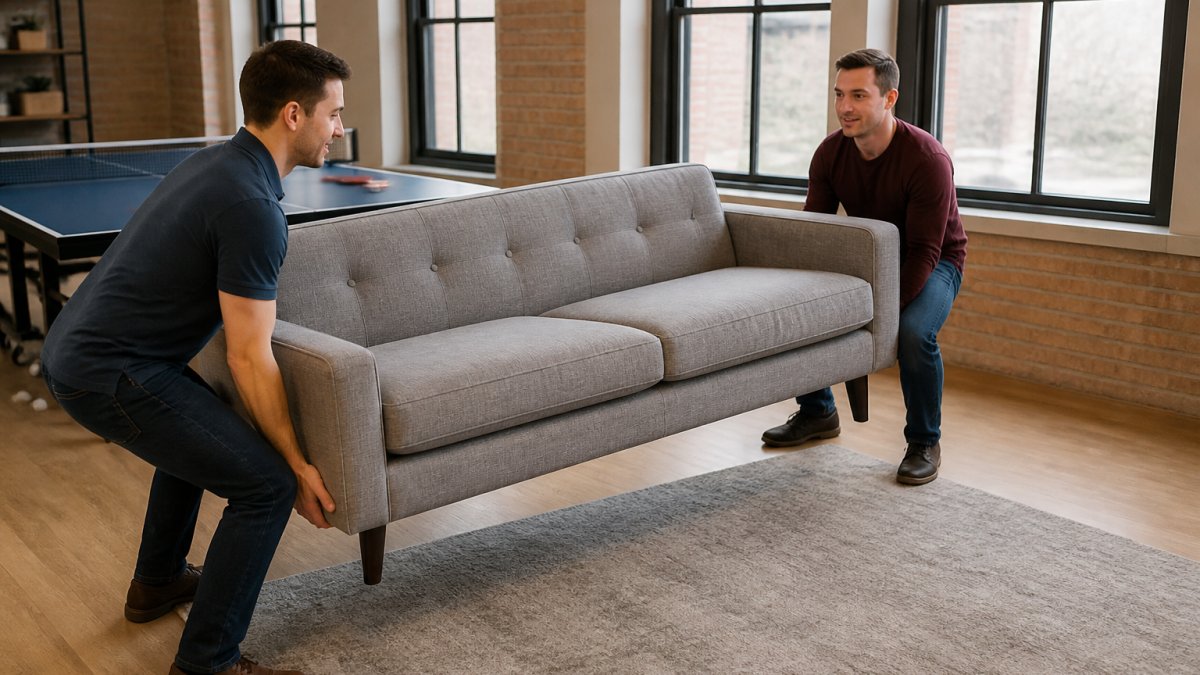
Team lifting a couch works when one person leads and both move on command. Assign a leader before you touch the frame.
The sequence:
- Leader counts down: "Ready, lift."
- Both lift on the same beat.
- Walk in step, leader calling turns.
- Set down together on the count.
Coordinate out loud.
Furniture Moving Straps and Dollies: Choosing the Right Equipment
Equipment choice should follow the load, not the other way around. Before grabbing whatever dolly is in the garage, check the item's weight, its dimensions and center of gravity, and the floor surface you will cross.
Start With the Load, Not the Tool
Three quick checks before you choose:
- Weight. If you cannot slide the item a few inches with moderate effort, it is probably beyond a solo lift and needs a dolly or a partner.
- Dimensions and center of gravity. Tall, narrow items tip. Wide, low items are easier to strap. Measure the footprint and the height before you buy or borrow anything.
- Floor type. Hard floors reward sliders. Carpet defeats them. Stairs defeat almost everything except a stair-specific hand truck or a two-person strap system.
Match the Equipment to the Job
| Equipment | Best For | Load Type | Watch Out For |
|---|---|---|---|
| Furniture dolly (flat, four-caster) | Boxes, small cabinets, stacked totes | Flat, stackable, low center of gravity | Tips on stairs and thresholds; casters catch on rugs |
| Appliance dolly (two-wheel hand truck with strap) | Refrigerators, washers, dryers | Tall, heavy, single unit | Needs the strap cinched tight; balance shifts as you tilt |
| Furniture sliders (felt or plastic) | Pushing on hard floors | Any flat-base item | Useless on carpet and thick rugs; can scratch soft wood if grit is trapped |
| Moving straps (forearm or shoulder style) | Couches, awkward loads | Bulky, two-person | Requires a partner and practice; load swings if you are out of step |
| Shoulder dolly | Long carries, wide items | Heavy, wide, two-person | Needs two people and clear overhead clearance |
Floor Type Changes the Answer
Floor surface is the variable most people ignore, and it decides whether a slider helps or hurts.
Straps and Sliders Are Not Interchangeable
If you are unsure whether a tool is rated for the item, size up or get a second person, barely adequate equipment is how moves go wrong.
Moving Furniture Up Stairs Safely: Route, Clearance, and Stop Rules
Moving furniture up stairs safely starts with a measurement, not a lift. Walk the route and check every turn before you carry anything.
Measure the narrowest point, doorway, stairwell turn, landing, against the furniture's widest dimension. If it does not fit, the piece comes apart or it does not go up.
Then plan who stands where:
- Going up: the stronger person takes the lower end. The load leans toward them.
- Going down: the stronger person takes the upper end.
- Keep the load tilted so the heavy side rests on the stairs, not on your arms.
Protecting Floors, Walls, and Doorways Along the Route
Wrap and pad before you lift.
- Floors: lay moving blankets along the route. Use floor protection under dollies.
- Walls and corners: tape cardboard or blankets to corners you will pass.
- Doorways: remove the door if clearance is tight. Tape the strike plate.
- The furniture itself: stretch wrap holds drawers shut and protects edges.
Clear the moving route completely. Cords, rugs and toys are trip hazards under a heavy load.
When to Stop Lifting and Call for Help
Most moving injuries are not single catastrophic events. They build from a lift that felt wrong, a grip that slipped, or a twinge that got ignored. The skill that separates a safe move from a bad one is knowing the stop conditions in advance and having a plan for when they appear.
Know the Warning Signs Before You Lift
Decide now what would make you stop. The common warning signs are:
- Sharp or stabbing pain in the back, neck, or shoulders during a lift.
- Numbness, tingling, or weakness in an arm or leg.
- A pop or tearing sensation at the moment of lifting.
- Loss of grip or the feeling that the load is getting away from you.
- Shortness of breath, chest pain, or dizziness, stop immediately and seek medical help.
How to Set the Load Down Safely
If you feel a warning sign, do not drop the item and do not twist to put it down. Set it down the same way you picked it up:
- Brace and communicate. If you have a partner, say "set it down" clearly before either of you moves.
- Bend at the knees and hips, keeping your back neutral, and lower the load toward the floor or the nearest stable surface.
- Keep the load close to your body as you lower it.
- Let your legs do the work on the way down, just as they did on the way up.
- Step away once the item is stable, and take stock before you try again.
When to Stop and Get Help
Stop and get help if any of these are true:
- The load feels beyond your control at any point.
- You cannot get a secure grip.
- The route has a turn you cannot see around.
- You are moving alone and the item is bulky or tall.
- You have already felt a twinge or a slip on this item.
After a Warning Sign: What to Do Next
If you are already sore from a previous move, our back pain relief tips for active adults cover what to do before you decide to stop for the day. The National Institute for Occupational Safety and Health also tracks how often overexertion injuries send people to the hospital, which is a useful reminder that the stop rule is not overcautious.
The best outcome is a move where you never need this section. Plan the lift, size the equipment, and decide your stop conditions before your hands touch the frame.
Protect Your Back Between Moves: Practice Smarter, Not Harder
A few practical moves:
- Use tools that remove bending entirely.
That last point is where MyPingPongBuddy comes in. Our handmade ball picker lets players and coaches scoop up balls without stooping. It breaks down in half for transport and comes with a 90-day full refund return policy.
Frequently Asked Questions
What is the safest way to lift heavy furniture?
Clear the path first, then stand close to the load with feet shoulder-width apart. Bend at the knees and hips, keep your back straight and your spine neutral, grip the item firmly, and lift with your leg muscles while keeping the load close to your body. Avoid twisting at the waist, and set the item down by reversing the same motion. If the piece is too bulky or heavy for one person, use a team lift or a furniture dolly instead of forcing it.
How do you lift furniture without hurting your back?
The biggest risks are bending at the waist, twisting while loaded, and holding the item away from your body. Bend your knees, keep your back straight, and keep the load close. Dismantle removable parts like drawers and legs to cut weight, and use furniture moving straps or a dolly for bulky pieces. Stop immediately if you feel sharp pain, and never push through strain to finish a move.
Should you push or pull heavy furniture?
Push whenever the surface allows it. Pushing uses your legs and body weight and keeps your spine in a stronger position, while pulling loads the back and shoulders and raises the risk of strain. Use furniture sliders on hard floors and clear the path first. On stairs, never push or pull a piece alone; plan the carry with a helper and keep the load balanced between you.
When should you hire professional movers for heavy furniture?
Call professionals when the item exceeds what two people can safely carry, when stairs or tight doorways make the route risky, or when anyone on the team has back pain or mobility limits. Solo-moving bulky furniture is a common cause of back strain. If you are unsure whether you can control the load through the whole route, that is your signal to hire help rather than test your luck.
Moving day punishes the unprepared back, and practice sessions do the same thing slowly. At MyPingPongBuddy, we built a tool that takes the bending out of ball cleanup, with a handmade design that breaks in half for easy transport and a 90-day full refund return policy. Get started with MyPingPongBuddy and save your back for the shots that matter.