 how-to
How to Set Up a Home Table Tennis Training Area
Table of Contents
- Assess Your Available Space and Table Tennis Room Size
- Choose the Right Table Tennis Table for Your Space
- Prepare a Level, Even Playing Surface
- Select Essential Table Tennis Training Equipment
- Design Your Solo Table Tennis Drills and Practice Routine
- Master Table Tennis Serve Practice at Home
- Optimize Lighting, Player Movement, and Safety
- Maintain Your Training Area for Long-Term Use
- Frequently Asked Questions
Last Updated: October 18, 2026
Assess Your Available Space and Table Tennis Room Size
Setting up a home table tennis training area starts with understanding what space you actually have. Most people rush this step and end up frustrated when their table doesn't fit or they can't move properly. Measure first.
Measure your room dimensions
Grab a tape measure and write down your room's length, width, and ceiling height. A full-size table tennis table is 9 feet long, 5 feet wide, and 2.5 feet tall (Rules of Table Tennis).
You also need at least 8 feet of ceiling clearance above the table for overhead shots and serves.
Calculate clearance requirements around the table
A table tennis training area needs space around the playing surface. Here's what works:
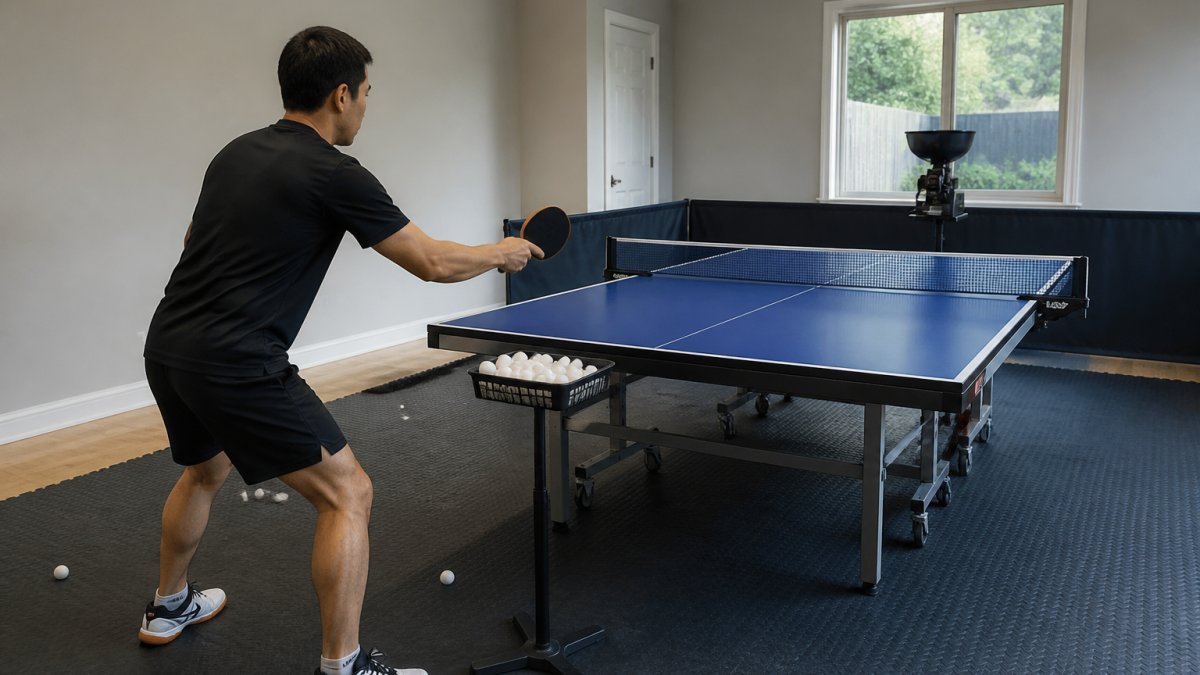
- Behind the baseline: 6-8 feet minimum for footwork and service positioning
- On each side: 3-4 feet for lateral movement during rallies
- Above the table: 8 feet minimum for overhead strokes
For solo drills, picture yourself taking three steps back from the baseline without hitting walls or furniture, that's your real minimum depth.
| Space Requirement | Minimum Distance | Reason |
|---|---|---|
| Behind baseline | 6-8 feet | Service and footwork |
| Sides of table | 3-4 feet | Lateral movement |
| Ceiling height | 8 feet | Overhead shots |
| Total room length | 20-22 feet | Full training setup |
Choose the Right Table Tennis Table for Your Space
Your table choice shapes everything else in your training area. The right one becomes invisible, so you focus on training, not equipment limitations.
Full-size versus compact table considerations
A regulation full-size table tennis table is 9 feet by 5 feet, the standard for serious training and what you'd find at clubs.
Compact tables run 6-7 feet long and 3-4 feet wide. They fit smaller spaces but sacrifice training quality: footwork patterns change and shot angles shift.
Here's the honest trade-off: a compact table takes up maybe 30% less floor space but reduces your effective training area by closer to 50%.
Folding tables for small spaces and storage
Folding tables break in half for storage and transport, which matters in tight spaces.
Cheap folding tables develop wobbles and warping after months of use. Look for solid construction and a consistent playing surface after repeated folding and unfolding.
Prepare a Level, Even Playing Surface
A warped or uneven table kills your training: the ball bounces unpredictably and you can't build consistent technique on a surface you can't trust.
Flooring options for indoor and outdoor setups
Concrete floors are flat and stable but hard on your joints during footwork drills. Wood floors absorb shock better but can warp with moisture changes.
Outdoor setups need a concrete pad or sealed patio, grass is uneven, dirt shifts, and gravel moves underfoot. Invest in a level concrete surface or skip outdoor training.
Check your floor with a long straightedge. Place it across the table's length and width.
Setting up and leveling your table correctly
Most tables come with adjustable legs. Use a level tool to check both directions, lengthwise and crosswise. Many players only check one direction and miss tilts in the other.
Place the level on the playing surface itself, not the frame. Once the surface reads level, lock down the leg adjustments so they don't shift during use.
If your floor is uneven, shim the table legs with plastic wedges until the surface reads level. Tighten everything securely.
Select Essential Table Tennis Training Equipment
You don't need much to train effectively at home, but poor equipment creates frustration and slows your progress.
Paddles, balls, and net setup
Start with two decent paddles. Cheap ones have inconsistent surfaces and poor feel; mid-range paddles ($25-50 each) provide reliable performance for solo training. You don't need tournament paddles to build fundamentals.
Use 40mm balls, the standard size. Cheap balls wear quickly and develop flat spots, so buy a dozen and rotate them during practice so they wear evenly.
The net is straightforward. Standard nets fit any table.
Ball collection and cleanup solutions
Here's where most training areas fall apart: ball cleanup. Chasing balls around the room for 10 minutes after each session eats into training time and kills focus.
MyPingPongBuddy solves this directly. The handmade design lets you scoop up balls without bending over repeatedly. For players with back pain or mobility issues, this changes everything.
For coaches running multi-ball drills, efficient collection means more training time per session, a tool that eliminates bending over saves hours across a week of practice.
Design Your Solo Table Tennis Drills and Practice Routine
Training alone at home requires structure. Without it, you hit random shots and don't build real skill. A routine keeps you focused and measurable.
Warm-up and mobility exercises
Start every session with 5-10 minutes of movement to prepare your body for explosive footwork and arm movements.
Do these before touching the paddle:
- Arm circles: 10 forward, 10 backward
- Leg swings: 10 forward, 10 sideways per leg
- Bodyweight squats: 15 reps to activate your legs
- Torso rotations: 20 total rotations, controlled pace
- Wrist circles: 10 each direction per wrist
Then move to the table and do light rallies against the table's edge or a wall for 3-5 minutes. This gets your eyes tracking and your footwork activated.
Technique-focused solo training sessions
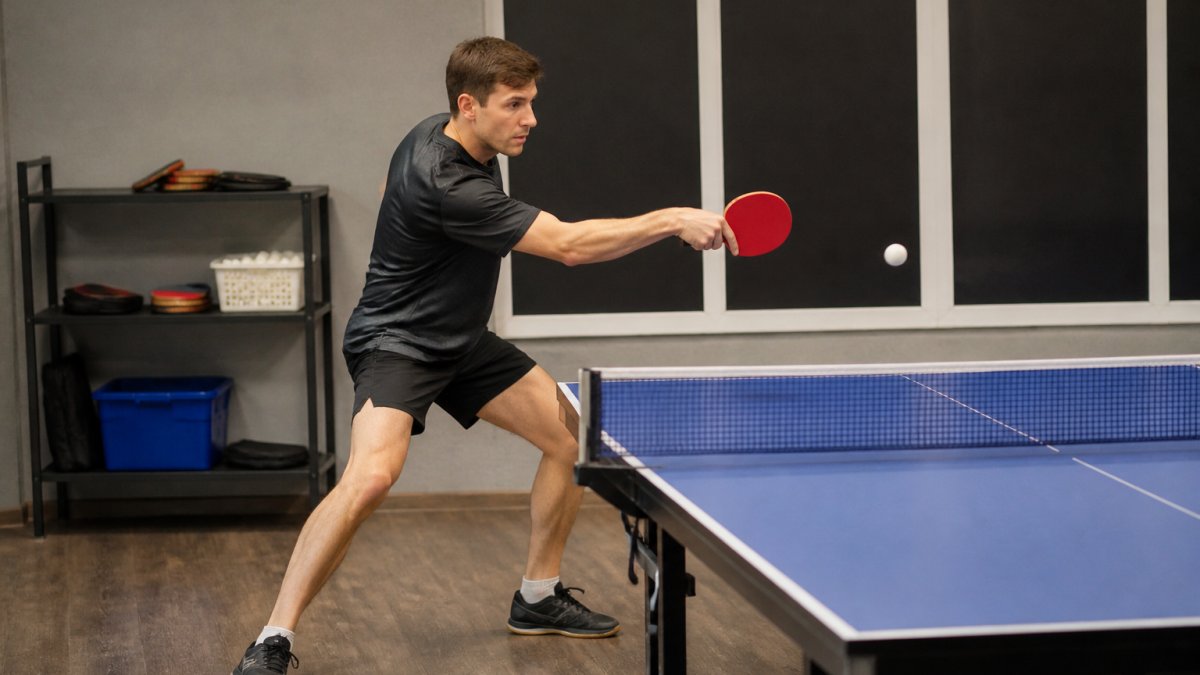
Solo training means hitting balls against the table or a wall. This builds consistency and footwork patterns. Structure your session in blocks:
- Forehand loops: 50 balls, focus on spin and depth
- Backhand loops: 50 balls, same focus
- Serve practice: 50 serves, alternating spin types
- Movement drills: 30 minutes of footwork patterns with ball contact
The key is repetition with intention, every shot teaches something about your technique.
Keep a simple log of what you worked on and how it felt. After a few weeks, patterns emerge and you see what needs more focus.
Master Table Tennis Serve Practice at Home
Your serve is the only shot you fully control. This makes serve practice the highest-return investment in solo training. You can practice serves indefinitely without a partner.
Service practice without a partner
Set up targets on the table's opposite side. Use tape to mark zones. Aim for specific targets instead of just hitting the table. This builds accuracy and consistency.
Practice different serve types in rotation:
- Flat serves with minimal spin
- Topspin serves with heavy rotation
- Backspin serves with underspin
- Sidespin serves with lateral movement
Hit 10 serves of each type, focusing on consistency. After 50 total serves, evaluate which feels strongest and which needs work.
Building consistency and accuracy
Consistency beats power in table tennis.
Track your success rate. Hit 20 serves to a specific target zone and count how many land. Write it down. Next session, try to beat that number.
After 4-6 weeks of focused serve practice, you'll notice significant improvement. Your serve becomes reliable. Your confidence grows. This translates directly to better performance when you play against others.
Optimize Lighting, Player Movement, and Safety
Your training environment either supports improvement or works against it. Lighting, movement space, and safety considerations shape whether training happens consistently or gets abandoned.
Lighting and visibility for accurate play
Poor lighting creates eye strain and inaccurate shot judgment. You misjudge ball speed and spin. Your footwork timing suffers. Invest in proper lighting.
Overhead lights work best. Position them so light falls evenly across the table without creating shadows or glare. Avoid single overhead fixtures directly above the table, these create shadows behind the net.
LED lights are ideal because they don't flicker and generate less heat. Aim for 500-750 lux of light on the playing surface.
Planning player movement and footwork space
Your movement space determines the drills you can practice. Cramped spaces limit footwork development. Open spaces let you build explosive movement patterns.
Ideally, you have room to take 3-4 steps in each direction from the baseline. This lets you practice recovery footwork and lateral movement.
Mark your movement zones with tape or cones. This helps you stay aware of walls and furniture during intense practice. You need to move freely without hesitation.
Safety considerations and household awareness
Table tennis training involves repetitive movements and rapid directional changes. Injuries happen when you're not paying attention to your environment.
Keep the area clear of clutter. Remove furniture that could catch you during movement. Ensure good footing, no loose rugs or slippery surfaces.
If you live with others, communicate your training schedule. Let family members know when you're practicing so they don't walk into the training area.
Keep water nearby. Hydration matters during intense training sessions. A water bottle positioned safely prevents dehydration from interrupting your practice flow.
Maintain Your Training Area for Long-Term Use
A training area that works today falls apart in six months without maintenance.
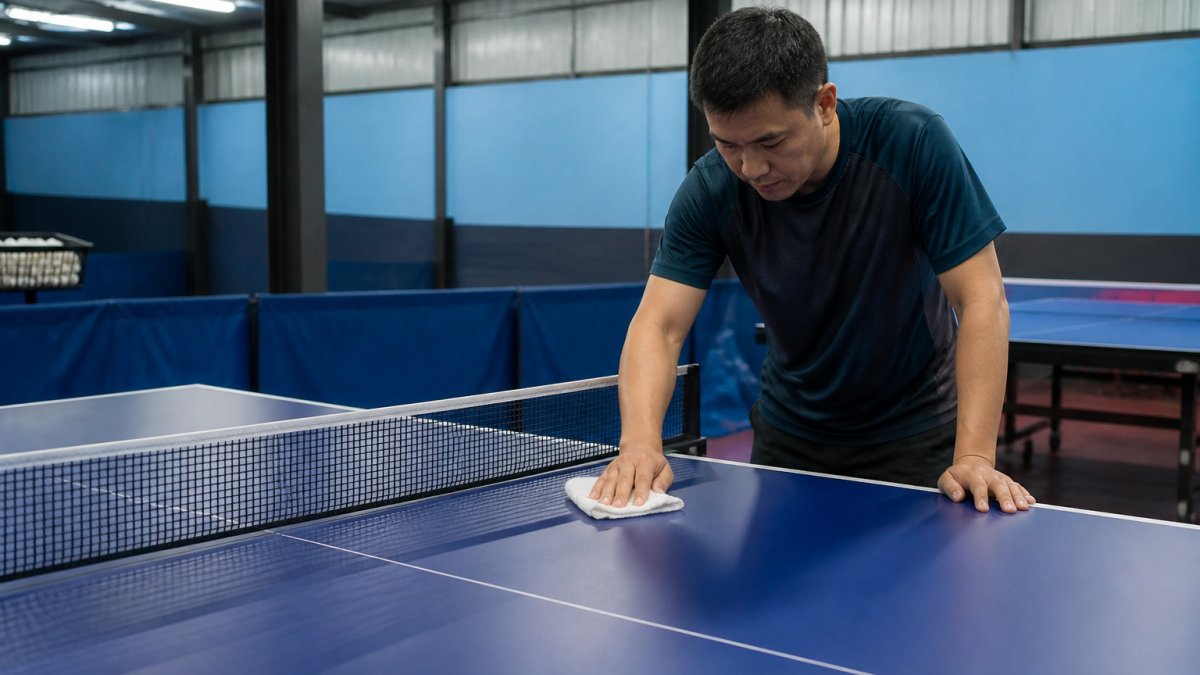
Check your table surface monthly. Wipe it down with a soft cloth.
Inspect the net monthly. Look for loose threads or damage.
Check table legs and adjustments quarterly.
Store paddles and balls properly. Keep them in a cool, dry place.
If you're using MyPingPongBuddy for ball collection, inspect it regularly.
Rotate your balls every few weeks.
Start with proper space assessment and a quality table.
Frequently Asked Questions
How much room do you need for a table tennis table at home?
A full-size table tennis table measures 9 feet long by 5 feet wide. For comfortable play and training, allow at least 3 feet of clearance on all sides of the table. This means your minimum room size should be approximately 15 feet by 11 feet. Smaller rooms work with compact tables (around 6 feet long) and reduced clearance of 2 feet, though this limits footwork and player movement during training.
What table tennis training equipment do you need to start at home?
Essential equipment includes a quality paddle for each player, regulation ping pong balls, and a net. For solo training, add a ball collection tool to speed up cleanup, especially during multi-ball drills. If you have lower back pain or mobility issues, a ball picker that eliminates bending is invaluable. Consider adding a training robot if you want to practice serves and rallies without a partner. Start with the basics and add specialized equipment as your training progresses.
Can you practice table tennis serves without a partner?
Yes. Practice serves by aiming at specific zones on the opposite side of the table, placing tape markers to target different areas. Focus on consistency over speed, performing 20-30 serves to each zone. Track your accuracy by counting successful serves. For advanced serve practice, use a training robot that returns balls, allowing you to work on serve-and-rally combinations. Solo serve practice builds muscle memory and technique that transfers directly to competitive play.
How do you set up a table tennis area in a small room or apartment?
Choose a compact or folding table tennis table that stores easily. Position it against a wall if space is extremely limited, though this restricts one side of play. Use a lightweight, portable ball collection tool that breaks down for storage. Ensure at least 2 feet of clearance on your playing side. Focus on solo drills and serve practice rather than multi-ball training. Proper lighting and a level floor remain critical even in compact spaces to maintain play quality and safety.