 comparison
Best Newgy Alternative for Home Practice: 2026 Guide
Table of Contents
- Why Players Are Searching for a Newgy Alternative
- Top Newgy Alternative Robots for Home Practice in 2026
- Comparison Table: Features and Pricing at a Glance
- The Best Ball Collector for Table Tennis: Completing Your Home Setup
- Benefits of Multi-Ball Training for Home Practice
- Table Tennis Robot Maintenance Tips for Long-Term Reliability
- Space, Noise, and Maintenance: What Competitors Miss
- Conclusion
- Frequently Asked Questions
Last Updated: September 20, 2026
Why Players Are Searching for a Newgy Alternative
Newgy built its reputation on dependable, mechanical ball machines, but players now want app control, richer spin variety, and quieter home operation. This guide from MyPingPongBuddy breaks down the best Newgy alternative for home practice in 2026, covering four machines that each solve a different problem.
Top Newgy Alternative Robots for Home Practice in 2026
Four machines stand out for home use, from budget entry-level to professional-grade simulation, each trading off differently on spin realism, portability, and cost.
| Robot | Starting Price | Best For | Key Limitation |
|---|---|---|---|
| Power Pong Omega | $2,299 | Serious players, coaches | High cost |
| iPong Trainer Motion | $199 | Beginners, small spaces | Basic spin control |
| Pongbot Nova S Pro | $899 | Intermediate players | Limited retail availability |
| CHAOFAN 36 Spins | $450 | Spin-focused technical work | Less strong build |
Power Pong Omega: Professional-Grade Spin and App Control
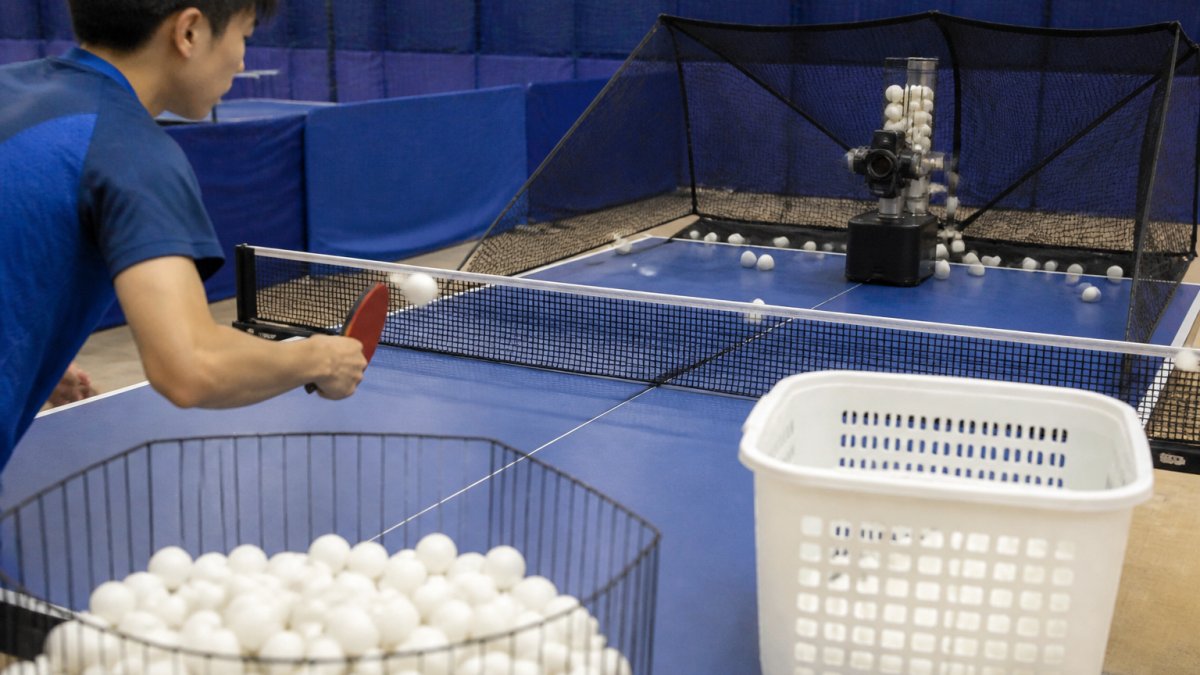
The Omega is the closest thing to a hitting partner money can buy. Its three-wheel head generates realistic topspin, underspin, and side-spin, while Bluetooth lets you control drills from a phone or tablet.
iPong Trainer Motion: Budget-Friendly Entry-Level Option
For beginners, nothing else comes close at $199. The Trainer Motion adds oscillation, so the head moves side to side and forces footwork practice rather than static blocking.
Pongbot Nova S Pro: The Balanced Mid-Range Choice
The Nova S Pro targets players graduating from entry-level gear. At $899, it delivers varied ball delivery, an easy drill-customization interface, and reliable ball recycling.
CHAOFAN 36 Spins: Maximum Spin Variety on a Budget
At $450, the CHAOFAN 36 Spins offers 36 spin combinations, an adjustable head angle, and a large hopper. For drilling return-of-serve technique, that variety is hard to beat at this price.
Comparison Table: Features and Pricing at a Glance
| Feature | Power Pong Omega | iPong Trainer Motion | Pongbot Nova S Pro | CHAOFAN 36 Spins |
|---|---|---|---|---|
| Price | $2,299 | $199 | $899 | $450 |
| Spin Types | Multi-wheel, full range | Basic | Moderate | 36 combinations |
| App Control | Yes (Bluetooth) | No | Yes | No |
| Oscillation | Yes | Yes | Yes | Yes |
| Best Skill Level | Advanced | Beginner | Intermediate | Intermediate |
The Best Ball Collector for Table Tennis: Completing Your Home Setup
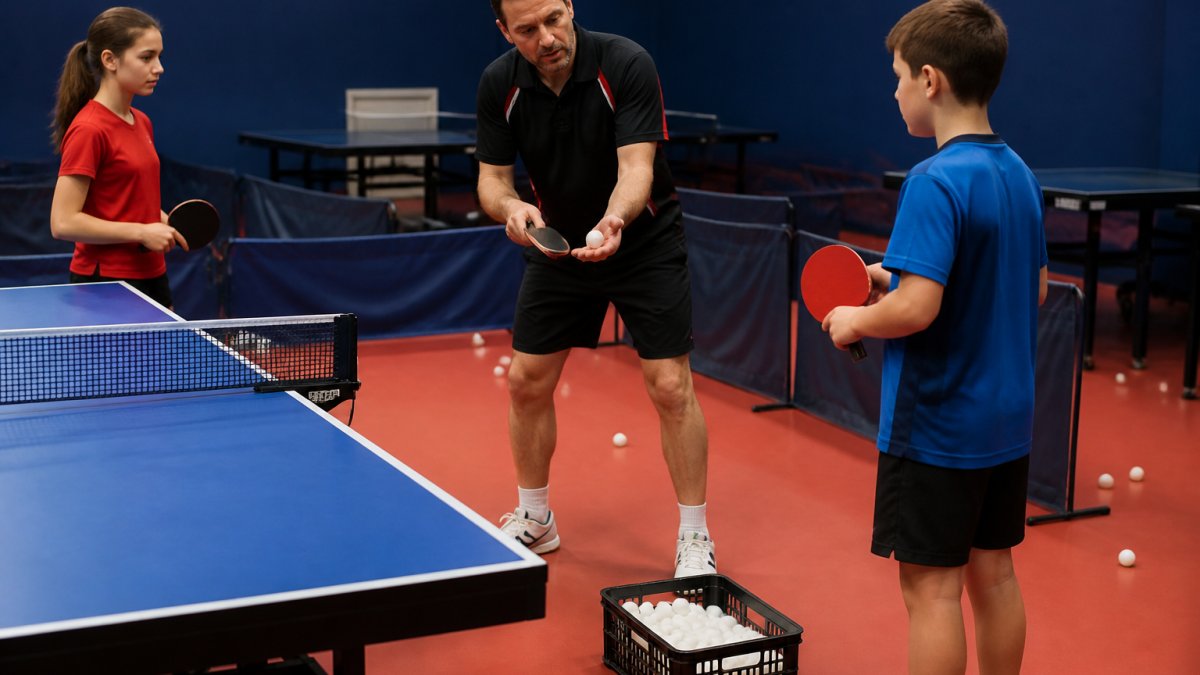
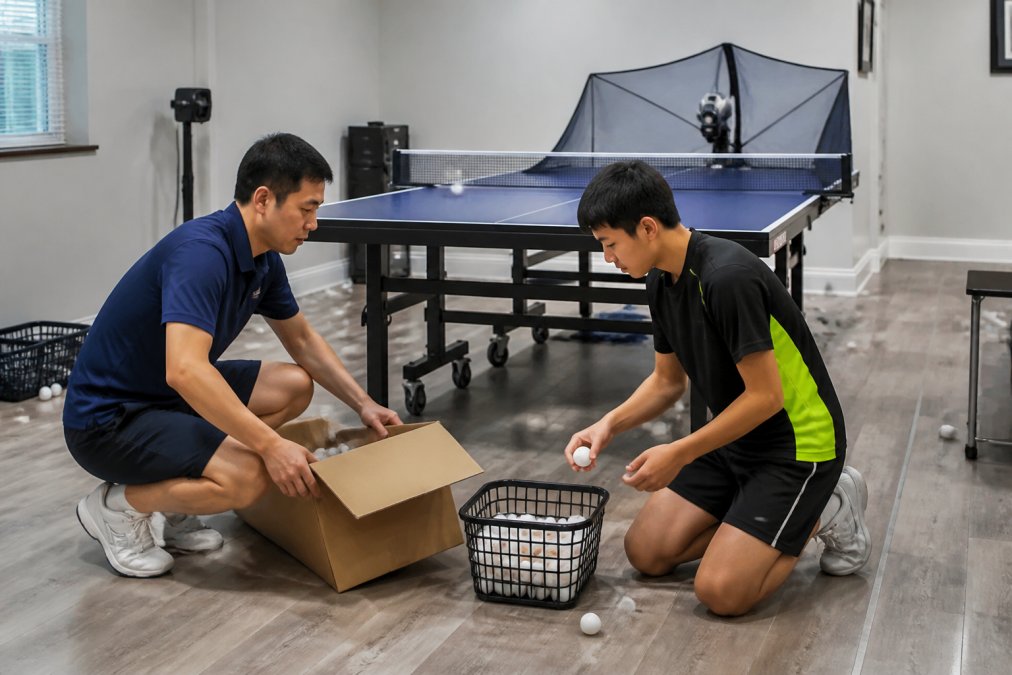
A robot feeds balls; something still has to pick them up. The best ball collector for table tennis lets you gather balls without bending over, because back strain, not ball feeding, ends most home sessions early.
Benefits of Multi-Ball Training for Home Practice
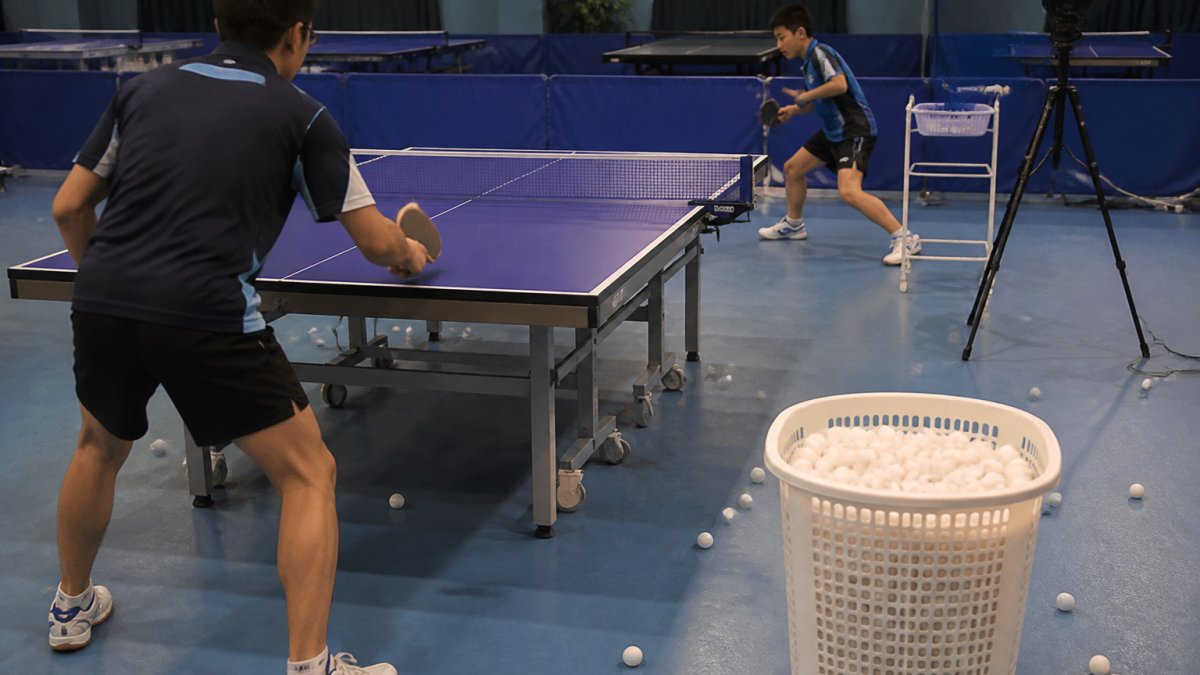
Multi-ball training builds stroke consistency faster than rallying, because a robot delivers the same ball repeatedly until the motion becomes automatic, repetition without a partner.
The benefits stack up quickly:
- Footwork practice with oscillation forcing lateral movement
- Stroke consistency through high-repetition feeding
- Spin variation exposure without needing a skilled practice partner
- Simulated match play when you program random shot placement
Table Tennis Robot Maintenance Tips for Long-Term Reliability
Table tennis robot maintenance tips matter more than most buyers expect, because dust and worn wheels degrade shot consistency long before a machine fails. This section treats maintenance as an ownership-cost question: what wears out, what replacement costs, and whether you can get the part.
The wear parts, in order of failure
Every robot in this category has the same short list of consumables:
- Throwing wheels. Rubber hardens and glazes with use. Multi-wheel heads (Omega, CHAOFAN 36 Spins) wear three wheels at once, so replacement cost triples versus a single-wheel unit.
- Ball hopper and feed channel. Plastic-on-plastic contact slowly scuffs the channel; a scuffed channel causes jams before it causes visible damage.
- Recycling net and frame. The net sags, the frame bends, and balls escape. This is usually the first thing to fail on net-based systems.
- Battery (cordless models). Capacity drops after a few hundred charge cycles, and replacement batteries are often the hardest part to source.
A practical maintenance schedule
- Every session: Empty the hopper and shake out dust. Balls carry grit into the feed channel.
- Every few weeks: Wipe the throwing wheels with a damp cloth and inspect for glazing, a shiny, hard surface means the wheel is feeding wrong spin even though it still feeds balls.
- Monthly: Check the recycling net for sag and the frame for bends. Re-tension or replace before balls start escaping.
- Quarterly: Update firmware on app-controlled models. Manufacturers patch Bluetooth pairing bugs, and skipping updates leaves connectivity unreliable.
Repairability: the question no buying guide asks
Most guides stop at purchase. The real ownership question is whether you can keep the machine running in year three. Before you buy any alternative, get answers to these:
- Are wheels sold individually or only as a full head assembly? A full-assembly-only policy can turn a $20 wear item into a $200 repair.
- Is the hopper and feed channel available as a separate part? If not, a cracked channel retires the machine.
- Is there a published firmware update path? App-controlled robots without ongoing firmware support lose their smart features first.
- What is the warranty length, and does it cover wear parts? Most warranties exclude wheels, hoppers, and nets, the exact parts that fail.
Long-term ownership cost, not just sticker price
A $199 entry-level machine with no spare-parts channel can cost more over three years than a $899 mid-range unit with stocked wheels and hoppers. Budget one wheel set per year on a multi-wheel head, one net replacement every 18 to 24 months, and a battery replacement in year two or three on cordless models. That annual upkeep figure, not the purchase price, is the honest comparison between alternatives.
Space, Noise, and Maintenance: What Competitors Miss
Three factors decide whether a robot actually gets used at home: room dimensions, noise, and long-term parts availability. Most buying guides skip all three, so this section treats them as first-class buying criteria.
Real-world space requirements: playing area vs. storage area
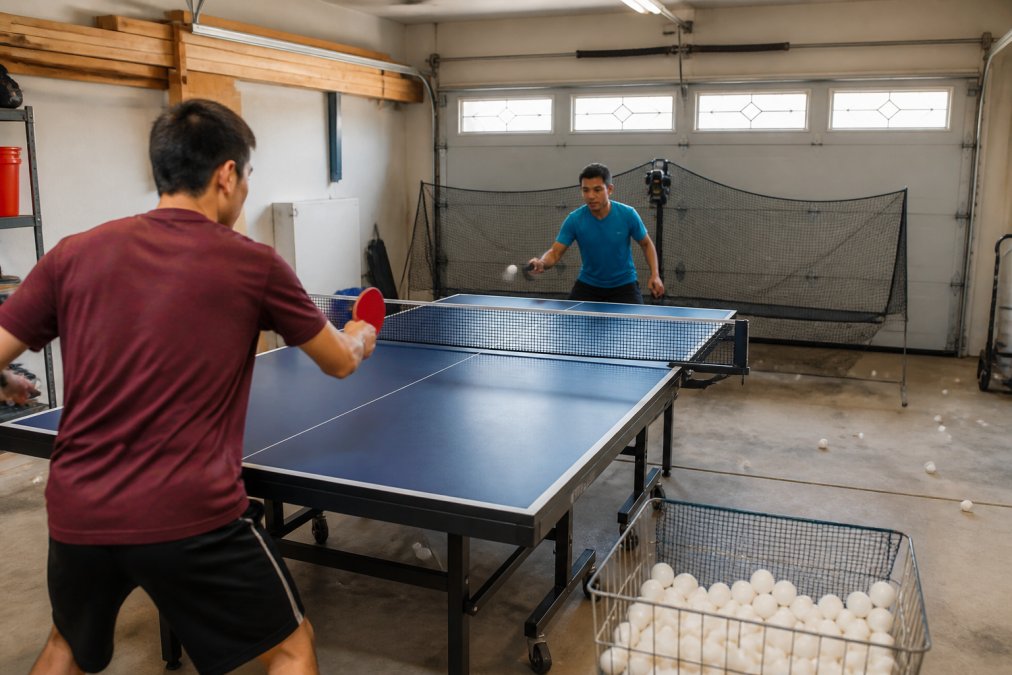
A regulation table is 9 feet long and 5 feet wide, and you need roughly 3 to 4 feet of clearance on each long side and behind each end for footwork and safe retrieval. That puts a comfortable home playing area at roughly 15 by 11 feet, about 165 square feet, before you add a robot.
- Entry-level units (iPong Trainer Motion class): about 1 cubic foot, fits on a shelf
- Mid-range units (Pongbot Nova S Pro class): about 2 to 3 cubic feet, needs a closet shelf or bin
- Professional units (Power Pong Omega class): 4 cubic feet or more once the net system and hopper are counted
Noise level and domestic environment impact
Noise is the most under-reported spec in this category. Manufacturers rarely publish decibel ratings, so judge by mechanism:
- Multi-wheel heads (Omega, CHAOFAN 36 Spins) run two or three motors simultaneously and produce a continuous whine plus a sharp ball-impact tick.
- Single-wheel and oscillation-only units (iPong Trainer Motion) are quieter at the motor but still click on every feed.
- Ball recycling adds a second noise source: balls rolling through plastic channels and dropping into a hopper create a rhythmic clatter that carries through shared walls.
Parts availability: the quiet killer
A machine with no spare wheels or hoppers becomes a paperweight once one component wears out. Before buying any alternative, confirm three things:
- Are replacement wheels sold individually, or only as a full head assembly?
- Is the ball hopper and recycling channel available as a separate part?
- Does the manufacturer publish a firmware update path for app-controlled models?
Integration with existing training apps
Some newer robots connect to training apps for drill tracking and progress logs, while older designs offer only a remote. If you already use a training app, check compatibility before you buy, a robot that only speaks its own proprietary app locks your drill history into one ecosystem. The practical question is whether it exports or syncs session data, or stays siloed.
Conclusion
Choosing a Newgy alternative comes down to matching spin realism, app control, and price to how you actually practice. The bigger challenge is the one nobody budgets for: cleanup, space, and long-term upkeep that decide whether the machine earns its place.
Frequently Asked Questions
What is the best Newgy alternative for home practice?
The best Newgy alternative depends on your budget and skill level. The iPong Trainer Motion at $199 suits beginners who need basic oscillation and portability. The Pongbot Nova S Pro at $899 offers a balanced feature set for intermediate players. For advanced training, the Power Pong Omega at $2,299 provides three-wheel spin realism and app control. Pair any robot with a handheld ball collector to reduce cleanup time and protect your back.
Are table tennis robots worth it for home practice?
Yes, if you train consistently. Robots deliver repeatable shots for stroke consistency and footwork practice without a partner. Entry-level models like the iPong Trainer Motion start at $199, making home practice accessible. The main benefits of multi-ball training include higher repetition volume and the ability to isolate specific shots. The trade-off is that robots cannot replicate live opponent unpredictability, so combine robot drills with match play.
How much do table tennis robots cost in 2026?
Prices range from $199 for entry-level models like the iPong Trainer Motion to $2,299 for professional-grade units like the Power Pong Omega. Mid-range options such as the Pongbot Nova S Pro sit around $899, while the CHAOFAN 36 Spins offers advanced spin variety at $450. Your budget should also account for accessories like a ball collector, which adds convenience and reduces physical strain during cleanup.
What features should I look for in a table tennis robot?
Prioritize oscillation, spin control (topspin, underspin, side-spin), and ball capacity based on your training goals. App-controlled models like the Power Pong Omega allow drill programming and firmware updates. Check assembly time, portability, and noise level if your practice space is shared. A ball recycling system and net collection reduce manual pickup. For home use, ensure the robot fits your table dimensions and storage area.
How does a table tennis robot improve your game?
Robots improve stroke consistency through high-repetition drills that build muscle memory. You can isolate specific weaknesses, such as backhand loops or footwork patterns, without needing a partner. Adjustable shot frequency, landing spot, and trajectory let you simulate match play scenarios. Combined with a ball collector, you spend less time picking up balls and more time training, which increases overall practice efficiency.