 comparison
Best Newgy Alternative for Ping Pong Coaches
Table of Contents
- Why Coaches Need a Newgy Alternative
- Comparison of Top Training Robots for Coaching
- Best Table Tennis Ball Collection Tools for Efficient Cleanup
- Table Tennis Serve Practice Drills for Beginners
- Key Features Coaches Should Evaluate
- Choosing the Right Solution for Your Facility
- Frequently Asked Questions
Last Updated: October 2, 2026
Why Coaches Need a Newgy Alternative
Finding the right training robot for your facility isn't just about features, it's about whether the equipment actually survives daily use and delivers consistent results for your students. Coaches working with table tennis robots know the reality: high-volume multi-ball practice demands machines built for punishment, not casual weekend play.
A best Newgy alternative for ping pong coaches needs to solve real problems. Your facility runs dozens of drills per week. Your machine cycles through hundreds of balls daily.
Beyond the robot itself, coaches face a secondary challenge that most equipment reviews ignore: ball collection.
This guide covers the best training robots for coaching environments, plus practical solutions for the operational challenges that come with them.
Comparison of Top Training Robots for Coaching
Selecting a training machine for your coaching operation requires evaluating durability, drill flexibility, and how well the equipment integrates into your actual workflow. The machines below represent different tiers of investment and capability.
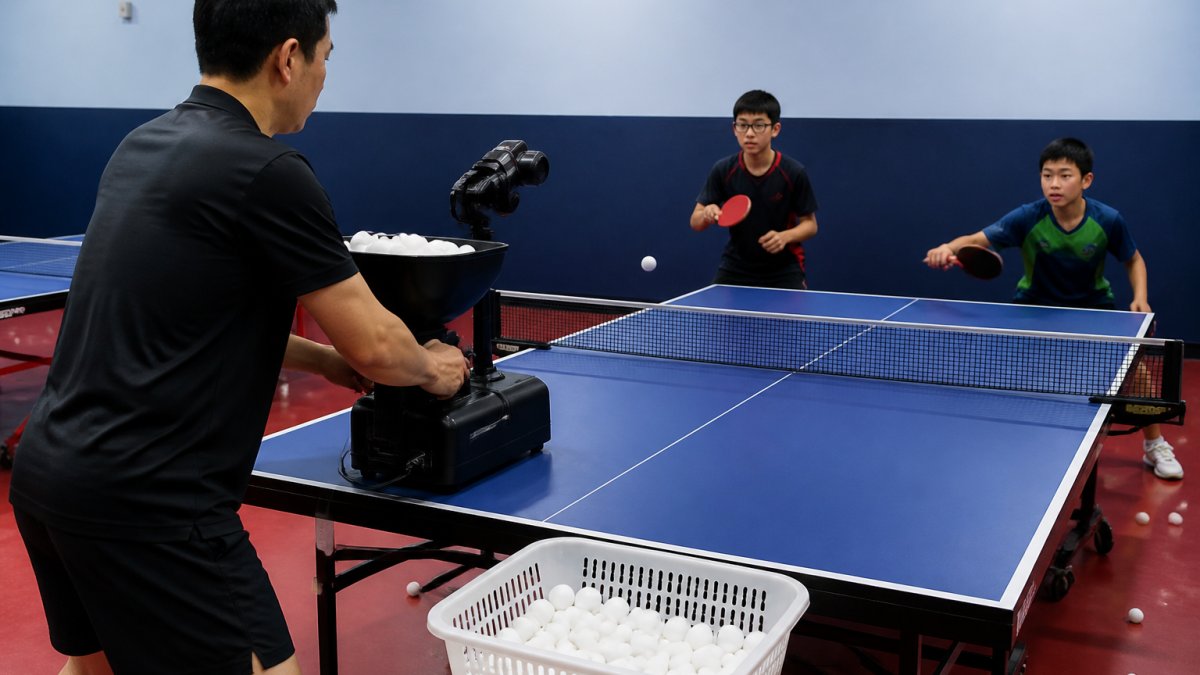
Power Pong Omega: Professional-Grade Durability
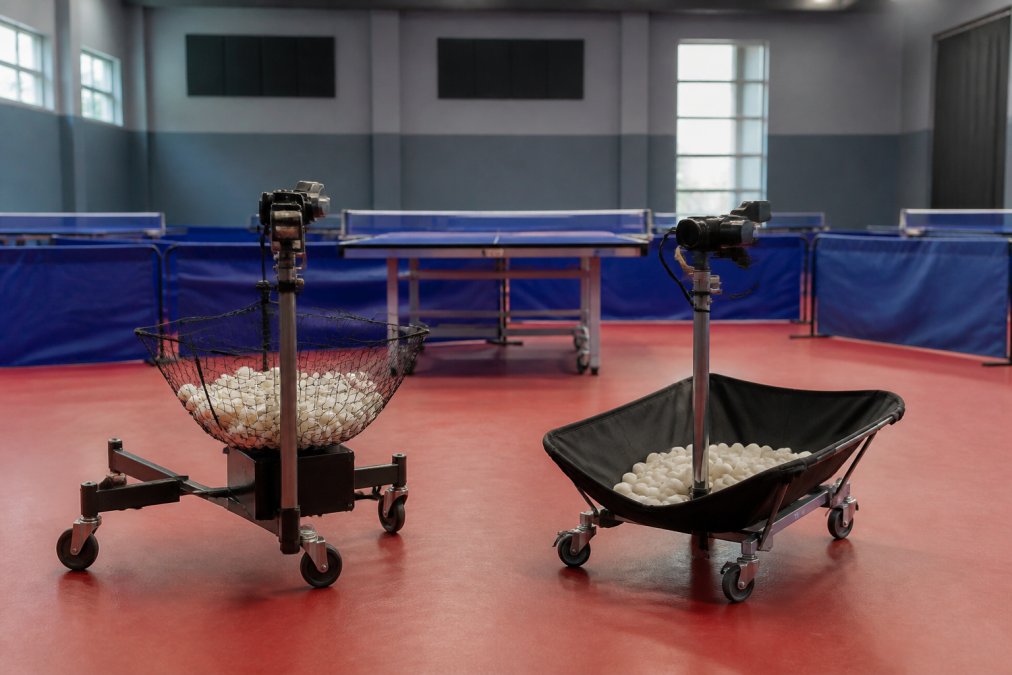
The Power Pong Omega is built for facilities that run training sessions from opening to closing.
Programmable drill sequences let you structure coaching sessions systematically.
The durability advantage becomes clear after six months of heavy use. The mechanical construction tolerates the vibration and stress that lighter machines struggle with.
Best for: Facilities running 15+ tables with structured coaching programs and high daily ball volume.
Pros:
- Superior build quality for intensive, daily use
- Highly customizable drill programming for skill progression
- Reliable ball recycling system reduces manual collection
- Professional-grade mechanical components
Cons:
- Higher upfront investment than entry-level alternatives
- Requires dedicated space due to size
Butterfly Amicus Series: Precision and Reliability
Butterfly has built its reputation on consistency. The Amicus Series delivers this through a multi-function head capable of producing complex spin combinations.
The compact design matters for facilities with space constraints.
What separates Butterfly from competitors is the extensive range of programmable training patterns. You're not limited to basic oscillation and speed settings.
Best for: Coaches prioritizing precision ball placement and extensive drill variety.
Pros:
- Industry-standard reliability with proven track record
- Extensive programmable training patterns
- Compact, space-efficient design
- Superior spin variety and trajectory adjustment
Cons:
- Significant investment for top-tier models
- Learning curve for advanced programming features
PongBot Omni S Series: Smart Technology Integration
The PongBot Omni S Series represents the modern approach to training equipment. AI-driven training modes adapt to player performance, adjusting ball difficulty based on success rates. High-precision ball placement ensures repeatable, accurate delivery across hundreds of repetitions.
Mobile app integration transforms how you manage drills. Rather than standing at the machine adjusting controls, you program sessions from your phone or tablet.
The hardware itself is tournament-ready. The mechanical components meet professional standards for durability and accuracy. Ball delivery consistency stays tight even after extended use, which matters when you're trying to develop stroke repeatability in your students.
Best for: Coaches seeking modern technology integration and adaptive training features.
Pros:
- AI-driven adaptive training modes
- Mobile app control for flexible drill management
- Highly responsive and accurate ball delivery
- Tournament-grade hardware durability
Cons:
- Steeper learning curve for software features
- Higher price point than mechanical-only alternatives
PongBot Nova S Pro: Budget-Friendly Professional Option
Not every facility needs the most advanced system. The PongBot Nova S Pro delivers professional reliability at a more accessible price point.
Adjustable spin, speed, and frequency settings provide enough flexibility for most coaching scenarios. The reliable ball feeding mechanism performs consistently across high-volume sessions.
Setup time matters when you're running back-to-back training sessions. The Nova S Pro requires minimal preparation.
Best for: Coaches needing reliable equipment without premium pricing or space constraints.
Pros:
- Excellent value for professional-grade features
- Easy to transport between training locations
- Straightforward setup and operation
- Reliable performance for fundamental skill development
Cons:
- Lacks advanced programming found in high-end models
- Limited spin complexity compared to professional systems
| Robot Model | Best For | Key Strength | Primary Limitation |
|---|---|---|---|
| Power Pong Omega | High-volume facilities | Durability and mechanical reliability | Higher investment required |
| Butterfly Amicus | Precision-focused coaching | Extensive programmable patterns | Significant cost for top models |
| PongBot Omni S | Tech-forward programs | AI-adaptive training modes | Software learning curve |
| PongBot Nova S Pro | Budget-conscious facilities | Value and portability | Limited advanced features |
Best Table Tennis Ball Collection Tools for Efficient Cleanup
The training robot handles ball delivery.
Manual collection wastes time and disrupts training flow. Your students finish a drill. Balls scatter across the table and floor. Cleanup begins. Training stops.
MyPingPongBuddy solves this through a clever, handmade design that eliminates the need to bend over while scooping up balls. The portable tool breaks down in half for easy transport between tables or storage. Coaches report that students actually engage with cleanup when using this approach, it becomes less of a chore and more of a natural part of the training rhythm.
The durability matters when you're using the tool multiple times daily across 15+ tables.
For facilities managing hundreds of balls daily, efficiency compounds. Saving five minutes per session across multiple coaches translates to hours per week.
Table Tennis Serve Practice Drills for Beginners
Teaching beginners serve consistency requires repetition and feedback.
Basic serve drill: Position the robot to return every serve to the same location. Your student serves 20 times to that target.
Serve-and-third-ball drill: The robot returns serves to a designated area.
Serve variation drill: Program the robot to return different spin types, topspin, backspin, no-spin.
The key with beginners is volume without fatigue. Twenty quality serves beats 100 rushed ones.
Key Features Coaches Should Evaluate
Not all training robots suit every coaching situation. Evaluating these specific features prevents costly mistakes.
Ball Delivery Consistency and Spin Variety
Consistency means the robot places the ball in the same location, with the same spin, at the same speed, shot after shot.
Spin variety determines what skills you can develop. A machine offering only topspin limits your ability to teach serves, returns against different spins, and tactical positioning.
Test this before purchasing: run 50 identical drills and measure where balls land. Variance of more than a few inches indicates insufficient consistency for serious coaching.
Durability and Maintenance for High-Volume Use
High-volume use means 500+ balls per day, five days per week. Most consumer-grade equipment fails within months under this stress.
Examine the mechanical components. Metal parts withstand repeated stress better than plastic. Bearings that support the oscillation mechanism should be sealed to prevent dust infiltration.
Maintenance requirements matter operationally. Equipment requiring daily cleaning or weekly adjustments becomes a burden. Professional machines need periodic maintenance but remain functional between service intervals.
Setup Time and Portability
Setup time directly impacts your coaching schedule. A machine requiring 15 minutes of assembly before each session wastes time. Portable machines that break down for transport allow flexibility, you can move equipment between facilities or store it efficiently.
Measure actual dimensions when assembled. A compact machine on paper might occupy more space than you expect once positioned. Verify power requirements. Some machines need dedicated circuits. Others work on standard outlets.
Choosing the Right Solution for Your Facility
Your facility's specific demands determine which equipment makes sense.
Start with volume. How many balls will you cycle daily?
Consider space. Compact machines suit small facilities. Larger machines demand dedicated areas.
Evaluate integration. Will the robot work alongside your existing equipment? Does it fit your coaching methodology?
Budget matters, but it's not the primary factor.
For ball collection specifically, MyPingPongBuddy addresses the operational reality that most reviews ignore.
Selecting the right training equipment transforms your coaching capability. The best Newgy alternative for ping pong coaches matches your facility's volume, supports your teaching methodology, and survives intensive daily use. Pair professional-grade robots with efficient cleanup solutions like MyPingPongBuddy, and you've built an operational system that prioritizes student development over equipment management. Start with your facility's actual demands, evaluate durability honestly, and invest in equipment that earns its place in your coaching program through consistent performance and reliability.
Frequently Asked Questions
What makes a Newgy alternative better for coaching than the original?
The best Newgy alternative for ping pong coaches offers improved ball delivery consistency, more advanced programmable drills, and better mechanical reliability for high-volume use. Professional alternatives like Power Pong Omega and Butterfly Amicus provide superior spin variation, faster oscillation settings, and integrated ball recycling systems that streamline coaching workflows. They also feature more intuitive interfaces for rapid drill adjustments during training sessions, allowing coaches to focus on player development rather than equipment setup.
Are table tennis robots worth the investment for a coaching facility?
Yes, training robots deliver measurable value for coaching facilities. They enable consistent stroke practice, reduce setup time between drills, and allow coaches to work with multiple students simultaneously through programmable sequences. Robots improve footwork training and stamina testing by delivering predictable ball patterns. For facilities running 15+ tables daily, automated training machines reduce manual ball feeding demands and increase practice efficiency. The durability and mechanical reliability of professional-grade robots justify the upfront cost through years of reliable use.
What are the best table tennis ball collection tools for coaches managing high-volume cleanup?
For coaching facilities, the most effective ball collection tools combine speed with ease of use. MyPingPongBuddy offers a portable, durable design that eliminates the need to bend over during cleanup, making it ideal for coaches with mobility concerns or those managing hundreds of balls daily. Its simple design breaks down for transport and handles repeated use without wearing out. For facilities requiring rapid collection during multi-ball practice sessions, tools that allow quick scooping reduce downtime between drills and improve overall training focus.
How do I know which training robot is right for my coaching needs?
Evaluate robots based on three factors: ball delivery consistency (how reliably it produces the same spin, speed, and placement), mechanical durability (can it handle daily use across multiple tables?), and programming flexibility (does it support the drill sequences your coaching style requires?). Entry-level options like PongBot Nova S Pro work well for beginner training with adjustable oscillation and speed settings. Professional-grade machines like Power Pong Omega and Butterfly Amicus suit advanced coaching with complex drill programming. Consider your facility size, budget, and player development goals when selecting.