 comparison
Ballsboy Alternative for Table Tennis Coaches: 2026 Picks
Table of Contents
- Why Coaches Look for a Ballsboy Alternative
- Quick Comparison: Best Ball Collector for Table Tennis
- MyPingPongBuddy: Handmade Scoop That Saves Your Back
- Robot Alternatives: Butterfly Amicus Prime, PongBot Nova S Pro, and Power Pong Omega
- Manual vs. Automated Ball Collection: Pros and Cons
- Table Tennis Multiball Training Drills That Demand Fast Retrieval
- Ergonomics, Durability, and Workflow Integration
- Frequently Asked Questions
Last Updated: September 27, 2026
Why Coaches Look for a Ballsboy Alternative
The hunt for a reliable Ballsboy alternative for table tennis coaches usually starts the same way: a session ends, hundreds of balls sit scattered across the floor, and someone has to bend over for every single one. That cleanup tax compounds across a full day of multi-ball feeding, and it lands hardest on the coaches who run the most sessions.
A ball collector for table tennis is a tool that gathers scattered balls from the floor with minimal bending, either through a scoop, a net, or an automated retrieval system built into a robot. Coaches care about these tools for one reason above all: court time is expensive, and every minute spent picking up balls by hand is a minute not spent on footwork drills, stroke consistency, or player development.
This guide from MyPingPongBuddy breaks down the real options, so you can match the tool to your session throughput instead of guessing.
Quick Comparison: Best Ball Collector for Table Tennis
The best ball collector for table tennis depends on your training volume. Here is how the main options stack up.
Comparison Table: Collectors and Robots
| Option | Type | Best For | Key Limitation |
|---|---|---|---|
| MyPingPongBuddy | Handheld scoop | Coaches and players with back pain | Manual operation |
| Butterfly Amicus Prime | Programmable robot | High-frequency multi-ball programs | High price point |
| PongBot Nova S Pro | Entry-level robot | Affordable beginner feeding | Fewer advanced features |
| Power Pong Omega | Professional robot | Heavy-duty coaching environments | Needs dedicated space |
| Net-style pickers | Manual net scoop | Basic home cleanup | Requires bending to press |
The pattern is clear: scoops solve ergonomics.
MyPingPongBuddy: Handmade Scoop That Saves Your Back
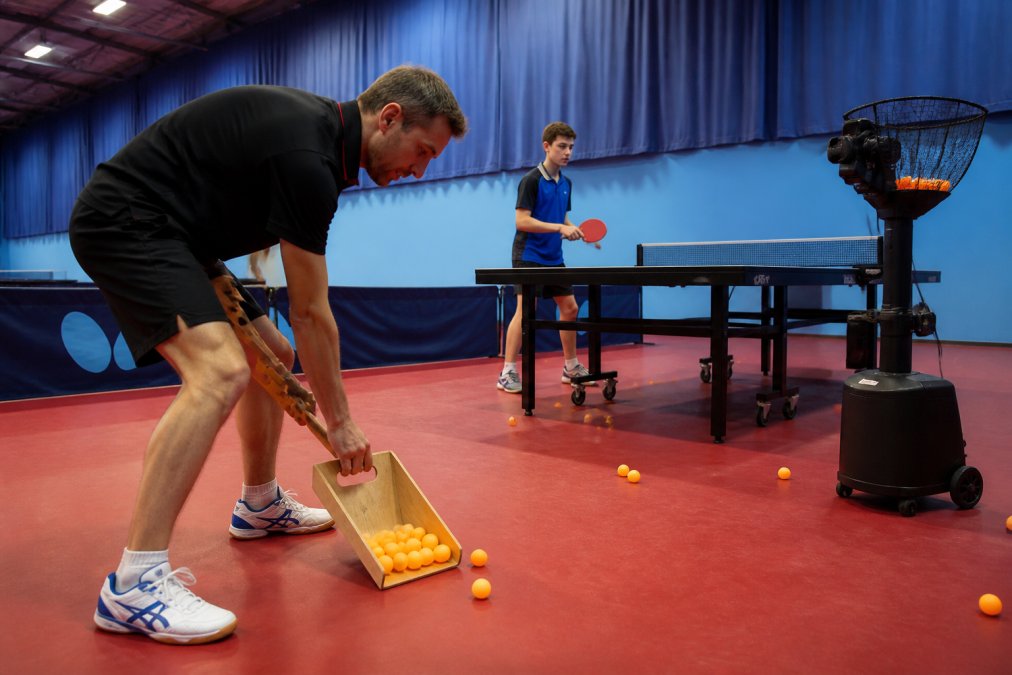
MyPingPongBuddy is a handmade ball scoop built for one job: getting balls off the floor without bending over. It breaks down in half for transport, so it fits in a gear bag alongside paddles and towels, and it carries a 90-day return policy with a full refund.
How It Works in a Coaching Session
The scoop sits low to the floor, so you push it forward and balls roll in without a single squat.
For coaches managing chronic back pain, this is the tool that changes the daily math. It is used by clubs and at SPIN locations in New York, Milwaukee, and Los Angeles, and it was issued as a prize at the 2012 Huntsman World Senior Games.
Robot Alternatives: Butterfly Amicus Prime, PongBot Nova S Pro, and Power Pong Omega
Robots solve a different problem than scoops: they feed balls and, in some models, collect them. The tradeoff is cost and setup time. Here is how the three most common coaching robots compare.
Butterfly Amicus Prime
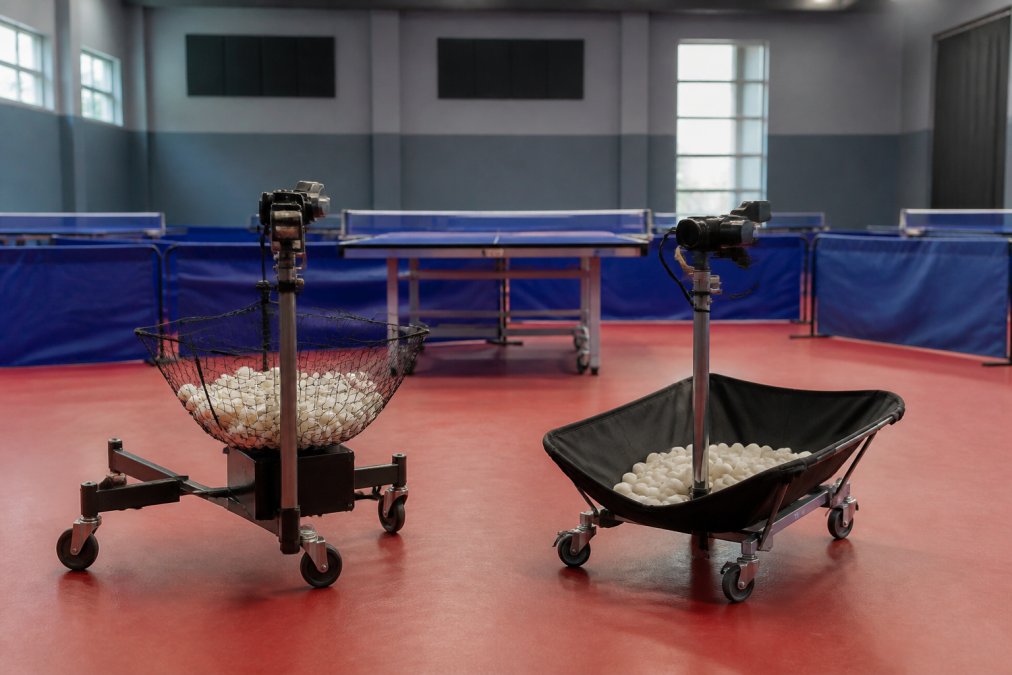
The Amicus Prime is a high-end robot with an app-controlled interface for programming complex sequences and a three-wheel head that varies spin and speed. Its integrated ball recycling system keeps play continuous, which cuts downtime between drills significantly. The catch is the price, which starts above $2,000 (Butterfly Amicus Prime product page). Best for professional coaches running programmable multi-ball blocks.
PongBot Nova S Pro
The Nova S Pro is the entry point. It is compact, adjusts speed and frequency, and sets up fast enough to move between training sessions. It lacks the advanced programming of premium models, but for beginner progression and consistent feeding, it does the job at a fraction of the cost (PongBot Nova S Pro details).
Power Pong Omega
The Omega targets high-volume environments. Build quality holds up to frequent use, and spin simulation is close to match-realistic. It needs dedicated space and setup time, so it suits a fixed training hall rather than a shared gym (Power Pong Omega specifications). Coaches running back-to-back sessions get the most from it.
Manual vs. Automated Ball Collection: Pros and Cons
The real decision is how many balls per session you actually handle, and how much bending your body can absorb before it affects your coaching.
The Ergonomic Math of Manual Pickup
A multi-ball session typically feeds 100 to 300 balls per player. If a coach runs four sessions a day, that is 400 to 1,200 balls handled daily, and every ball picked up by hand is one bend at the waist. Over a five-day week, that is 2,000 to 6,000 bends, the repetitive strain pattern that shows up as lower back pain in coaches by mid-career.
Throughput: What Each Method Actually Clears
- Hand pickup: roughly 20 to 30 balls per minute with full bending, and fatigue compounds across a session.
- Manual scoop: roughly 60 to 100 balls per minute on open floor, with no bending if the scoop is designed for push-forward collection.
Cost and Setup Trade-offs
Manual scoops require no power, no calibration, and no storage footprint beyond a gear bag.
When Each Method Wins
Manual collection wins when you coach in shared or temporary spaces, when your volume is moderate, and when ergonomics, not raw speed, is the bottleneck.
Table Tennis Multiball Training Drills That Demand Fast Retrieval
Fast retrieval matters most in drills where balls pile up faster than you can chase them. But the bigger opportunity most guides miss is not which drill you run, it is how you sequence collection into the drill so downtime never interrupts the player's rhythm. Here is how to integrate a collector into three common multi-ball drills.
The Three-Corner Feed
You feed to forehand, middle, and backhand in rotation while the player recovers between each. Balls scatter wide, and a slow collector stalls the drill every 30 seconds.
The Rapid-Fire Block
Feed 20 balls in under a minute to build reaction speed. Retrieval speed directly caps how many reps the player gets.
The Robot-Plus-Coach Combo
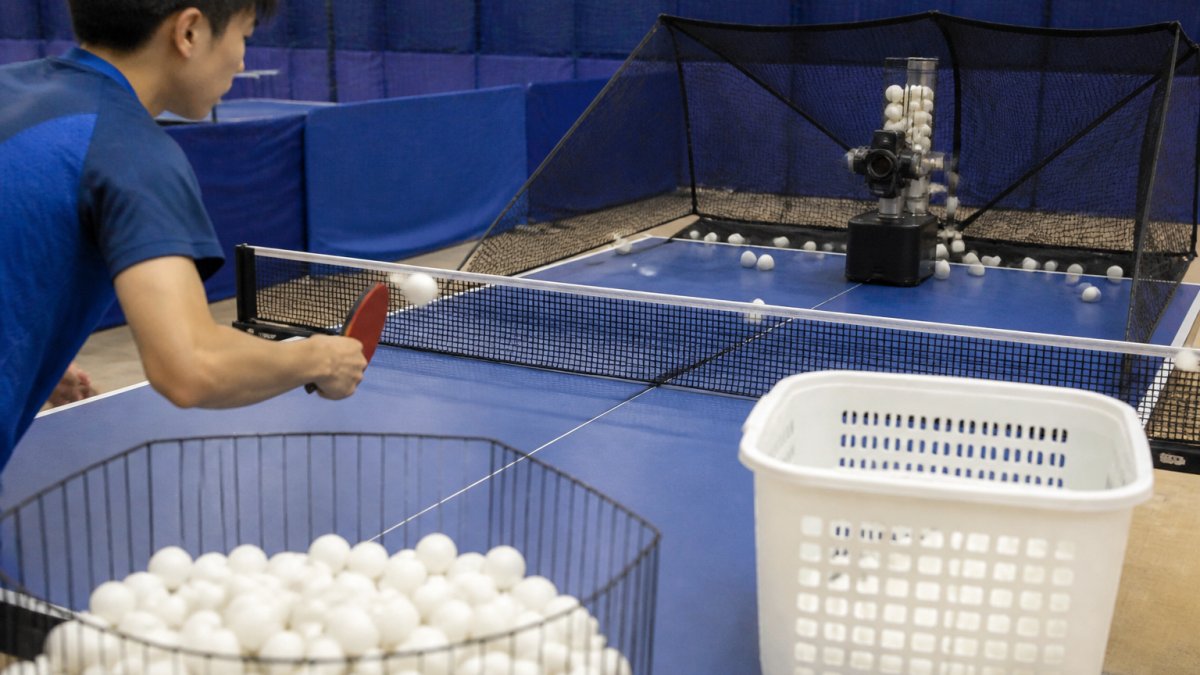
The robot handles the repetitive feed while you correct technique. Here the robot's recycling system carries the load, and your scoop handles the overflow.
A Note on Drill Sequencing
Most coaches run drills in order of intensity: warm-up feeds, then footwork patterns, then rapid-fire, then cool-down consistency work. Match your collection method to that arc. Manual scoops handle the low-intensity blocks without breaking rhythm. If you sequence collection into the rest beats of each block, you stop treating cleanup as a separate phase of the session, and you get back the court time you were losing between drills.
Ergonomics, Durability, and Workflow Integration
Ergonomics decides whether a tool survives daily use. A scoop that forces you to press down hard with your shoulder is no better than bending over, so look for a design that lets you push forward with your legs instead.
Frequently Asked Questions
What is multiball training in table tennis, and why does ball collection matter?
Multiball training involves a coach feeding a continuous stream of balls to a player to build footwork, stroke consistency, and reaction speed. Because dozens of balls end up scattered across the court after each drill, collection speed directly affects how many repetitions a player gets per session. A fast, ergonomic collector keeps the session flowing and reduces downtime between drills.
Is a manual ball collector better than a robot for coaches on a budget?
It depends on your training goals. A manual collector such as MyPingPongBuddy is a low-cost tool that speeds up cleanup and reduces bending.
How does MyPingPongBuddy compare to standard ball collection methods?
Standard net scoopers require bending and can be awkward to maneuver. MyPingPongBuddy is a handmade scoop that lets you pick up balls without bending over, and it breaks down in half for transport. Customers report that students pick up balls faster with it than with net scoopers. It also comes with a 90-day full refund return policy, so you can try it risk-free.
What should I look for in the best ball collector for table tennis?
Focus on ergonomics (does it prevent bending?), durability (will it hold up to daily club use?), capacity (how many balls does it hold?), and portability (does it fit in your bag or storage?). For coaches running high-volume sessions, a collector that integrates smoothly into your existing workflow, such as one that can be used one-handed while you feed balls, saves the most time.
Can one MyPingPongBuddy handle a club with 15 tables?
A single MyPingPongBuddy is designed for personal or small-group use. For a club with 15 tables collecting hundreds of balls daily, you would likely need multiple units or a combination of tools. Many clubs assign one collector per table or per coaching station. The handmade construction and 90-day return policy let you test one unit before committing to a larger order.
The real challenge for coaches is not choosing between a scoop and a robot; it is building a retrieval workflow that keeps balls off the floor without eating your session time. MyPingPongBuddy solves the ergonomic half of that problem with a handmade scoop that eliminates bending, breaks down in half for transport, and improves training focus by cutting cleanup time. Get started with MyPingPongBuddy and keep your players drilling instead of watching you pick up balls.