 how-to
How to Improve Table Tennis Serve Spin
Last Updated: October 22, 2026
Quick Summary
To improve table tennis serve spin, master the brush technique by grazing the ball's surface rather than hitting hard, maintain consistent contact points on the ball, and use proper wrist snap at the moment of contact. Practice with structured drills like the consistency drill and target drill to build reliable spin serves.
- The consistency drill requires executing the same serve type 20 times in a row, targeting 15 out of 20 serves landing cleanly in the service box.
- Backspin serves use a closed racket face angled downward with contact on the lower half of the ball combined with a downward wrist snap.
- Topspin serves use an open racket face angled upward with contact on the upper half of the ball and an upward wrist snap.
- A complete practice session should last 45-60 minutes with three to four sessions per week for noticeable progress.
- Hitting too hard reduces spin production; a slower brush motion with perfect contact generates far more spin than a fast swing with sloppy technique.
Table of Contents
- Understanding Spin Mechanics in Your Table Tennis Serve
- Table Tennis Serve Practice Drills for Beginners
- How to Serve Backspin in Table Tennis
- Mastering Topspin and Sidespin Serves
- Build a Table Tennis Serve Practice Routine
- Table Tennis Serve Training Equipment That Works
- Common Mistakes That Limit Your Serve Spin
- Frequently Asked Questions
Understanding Spin Mechanics in Your Table Tennis Serve
The foundation of a powerful spin serve starts with understanding how racket angle, contact point, and brush technique work together. Spin is created when the racket surface moves across the ball rather than straight through it. This sideways motion combined with the ball's rotation generates the spin that makes your serve unpredictable and hard to return.
Why Racket Angle and Contact Point Matter
Your racket angle determines the direction and intensity of spin. A closed racket face (angled downward) creates backspin. An open racket face (angled upward) creates topspin. The contact point on the ball is equally critical, hitting near the equator produces different spin than hitting the top or bottom of the ball.
The sweet spot for spin generation is typically on the upper half of the ball for topspin and the lower half for backspin. Precision here separates serves that barely rotate from serves that dip sharply or curve unpredictably across the net.
The Role of Wrist Snap and Brush Technique
Wrist snap accelerates the racket through the contact zone. A quick flick of your wrist at the moment of contact amplifies spin without requiring excessive arm speed. Brush technique, dragging the racket surface across the ball, is what actually creates the spin.
Many players mistakenly think power comes from hitting hard. In reality, controlled brush motion generates far more spin than raw speed. The racket should graze the ball's surface rather than collide with it. This grazing motion is what causes the ball to rotate rapidly.
Table Tennis Serve Practice Drills for Beginners
Building reliable spin serves requires structured practice. These drills isolate specific elements of the serve so you can develop each skill independently before combining them.
The Consistency Drill: Building Reliable Spin
This drill focuses on repeating the same serve motion 20 times in a row. Pick one serve type, backspin, topspin, or sidespin, and execute it identically each time. Count how many serves land in the service box without a net touch.
Start with a target of 15 out of 20 serves landing cleanly. Once you hit that consistently, increase to 18 out of 20.
The consistency drill teaches your body the exact motion needed. Repetition is what locks in technique. Most players skip this step and wonder why their serves fall apart under pressure.
The Target Drill: Precision and Placement
Place cones or tape markers in different areas of the opponent's service box. Serve 10 balls to each target zone. Start with the widest targets (like the service box corners) and progress to smaller zones (like the sideline near the net).
This drill develops placement accuracy. A spin serve that lands in the same spot every time is far more dangerous than a heavy-spinning serve that lands randomly. Your opponent can't prepare if they don't know where the ball will land.
How to Serve Backspin in Table Tennis
Backspin serves are among the most effective serves in table tennis. A heavy backspin serve forces your opponent to lift the ball, giving you an attacking opportunity. Understanding the mechanics of backspin will help you improve table tennis serve spin production immediately.
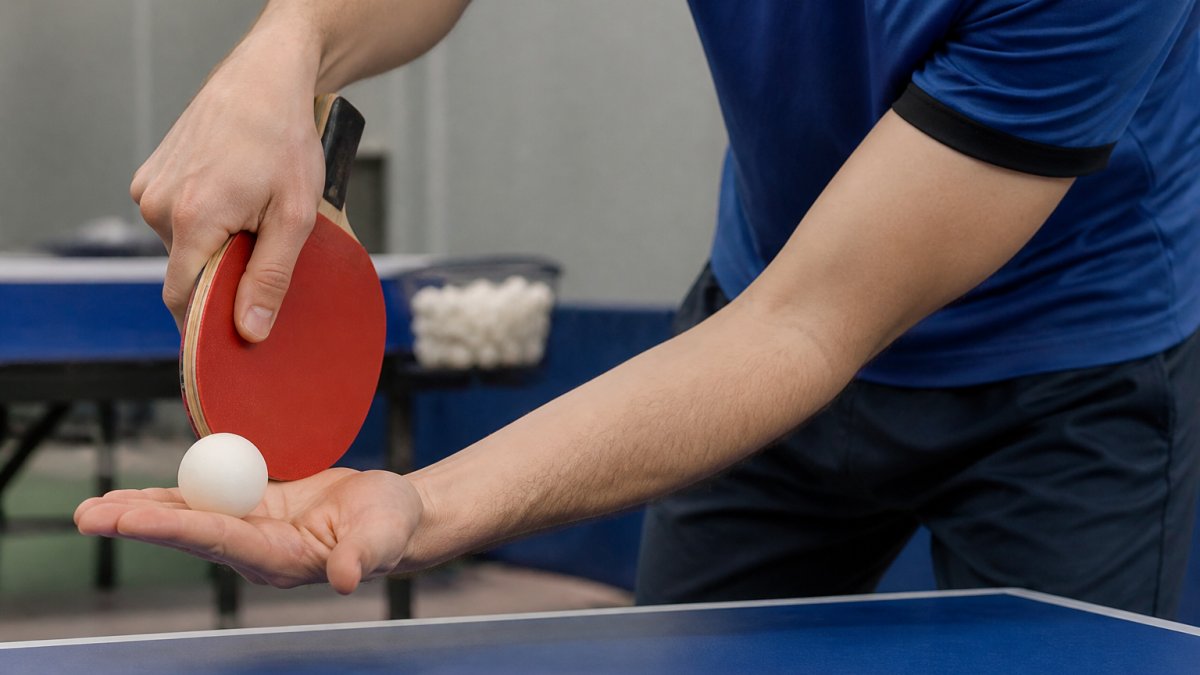
Grip and Racket Positioning for Backspin
Hold your racket with a closed face, angled downward so the hitting surface points toward the floor at roughly a 45-degree angle. Your grip should feel natural and relaxed, not tense. Tension limits wrist mobility and reduces spin.
Position the ball at about waist height, slightly in front of your body. Your contact point should be on the lower half of the ball, roughly at the ball's equator or slightly below.
Execution: The Downward Brush Motion
Start with your racket held above the ball. Move the racket downward and forward in one smooth motion, brushing the lower half of the ball as you go.
At the moment of contact, snap your wrist downward. This wrist snap accelerates the racket and amplifies the spin. The combination of downward motion, brush contact, and wrist snap creates heavy backspin that makes the ball dip sharply after crossing the net.
Common mistakes include hitting too hard (which reduces spin) and contacting the ball too high (which produces weak spin). Focus on the brush motion first. Speed comes naturally once your technique is solid.
Mastering Topspin and Sidespin Serves
While backspin is defensive, topspin serves are aggressive. Topspin serves clear the net easily and land deep in the service box, pushing your opponent back. Sidespin serves curve sideways, making them difficult to read and return.
Topspin Serve Technique
For topspin, use an open racket face angled upward at roughly 45 degrees. Contact the upper half of the ball, slightly above center. Your motion should be upward and forward, brushing the ball as you move.
Start with your racket below the ball. Accelerate upward and forward, making contact on the upper half. Snap your wrist upward at contact to amplify spin. The result is a serve that clears the net easily and lands with forward rotation that's hard to attack.
Topspin serves are especially effective against players who struggle with high-bouncing balls. The upward rotation makes the ball bounce higher than expected, disrupting their rhythm.
Sidespin Serve Technique
Sidespin is created by brushing the side of the ball. Use a racket face that's roughly perpendicular to the net (neither fully open nor fully closed).
Your motion should be sideways and forward. If you're right-handed and want the ball to curve left, brush the left side of the ball with a motion that goes from right to left.
Sidespin serves are unpredictable because they curve through the air. Your opponent must adjust their positioning to handle the curved path. Combining sidespin with topspin or backspin creates serves that are nearly impossible to read.
Build a Table Tennis Serve Practice Routine
Effective practice requires structure. A well-designed routine balances warm-up, technique focus, and high-volume repetition. This routine works whether you're practicing alone or with a partner.
Warm-Up and Technique Focus
Start with 5 minutes of light serves using no spin. This warms up your shoulder, elbow, and wrist while establishing your basic serving motion. Then spend 10 minutes on one specific serve type, backspin, topspin, or sidespin.
During technique focus, concentrate on perfect form rather than volume. Execute 20-30 serves of your chosen type, emphasizing the brush motion and contact point. Quality over quantity here. If your form breaks down, stop and reset.
Progressive Volume and Variety
After technique work, increase volume. Hit 50-100 serves, rotating between your three main serve types. Aim for consistency, landing 80% or more of your serves in the service box.
In the final 10 minutes, practice serving under pressure. Set a target (like serving to the corners) and count successful serves. This game-like pressure builds confidence and reveals weaknesses in your technique that only appear when you're focused on placement rather than just spinning the ball.
A complete practice session should last 45-60 minutes. Shorter sessions are fine for maintenance, but improvement requires this level of commitment. Practice three to four times per week for noticeable progress.
Table Tennis Serve Training Equipment That Works
The right equipment makes practice more efficient. A ball collection tool simplifies cleanup, which means more time actually serving. Your racket and rubber also influence how easily you generate spin.
Ball Collection Tools for Efficient Practice
Collecting balls between drills wastes time and energy. A tool designed for quick ball pickup saves significant time during practice sessions. At MyPingPongBuddy, a simple ball collection tool eliminates repetitive bending.
The best collection tools are portable and durable. They should scoop balls quickly without requiring you to bend over repeatedly, especially important if you have back pain or mobility limitations.
Look for tools that pick up multiple balls at once. Single-ball pickers waste time. A scoop that holds 5-10 balls per collection run cuts your cleanup time in half, leaving more time for actual practice.
Racket and Rubber Selection for Spin Development
Your racket and rubber directly affect how easily you generate spin. Rubbers with higher friction coefficients grip the ball better, making spin production easier.
Choose a racket with good balance and control rather than maximum power. A slightly heavier racket (around 95-100 grams) provides better stability through the serve motion. A lighter racket requires more technique to generate spin.
Inverted rubber (smooth side out) is standard for spin serves. Pimpled rubber reduces spin, so avoid it if spin development is your goal. Most modern rubbers are inverted, so this is rarely an issue unless you're using older equipment.
Common Mistakes That Limit Your Serve Spin
Even with good technique, small errors can sabotage your spin development.
Hitting too hard is the most common error. Players assume power creates spin, but the opposite is true.
Inconsistent contact points destroy spin development.
Poor wrist position limits your range of motion. Keep your wrist relaxed and flexible.
Neglecting footwork is another mistake. Your feet position your body correctly for the serve.
Finally, practicing without a clear focus wastes time.
To improve table tennis serve spin requires understanding the mechanics, practicing with purpose, and using the right tools.
A structured practice routine, starting with technique focus and progressing to high-volume repetition, creates measurable improvement.
Frequently Asked Questions
What part of the ball should you contact to create more spin on your serve?
Contact the lower half of the ball for backspin, the upper half for topspin, and the side for sidespin. The exact contact point determines the direction and amount of rotation. Brush the ball rather than hitting it flat, this friction generates spin. Most beginners improve spin dramatically by shifting from a flat hit to a brushing motion with proper racket angle.
How often should you practice table tennis serves to develop better spin?
Aim for 15-20 minutes of dedicated serve practice 3-4 times per week. Quality matters more than quantity. Focus on one spin type per session rather than mixing all types. Track your consistency by counting successful serves out of 10 attempts. Most players see noticeable improvement within 2-3 weeks of consistent, focused practice.
Why is my table tennis serve not spinning?
The most common reasons are hitting the ball too flat instead of brushing it, incorrect racket angle, or insufficient wrist snap. Check that your racket face is angled correctly for your target spin type. Ensure you're brushing the ball's surface with a snapping wrist motion rather than simply striking it. Poor ball contact point also reduces spin, practice hitting the specific zone needed for your serve type.
What equipment helps you practice table tennis serves effectively?
A quality rubber with good spin characteristics, a ball collection tool to speed up practice without bending repeatedly, and a training partner or ball robot for feedback. A ball scoop makes high-volume practice sustainable, especially for coaches running multi-ball drills. Many facilities use portable ball collection devices to maintain focus on technique rather than spending time chasing balls across the floor.