
 how-to
How to Prevent Injury in Table Tennis: 2026 Guide
Table of Contents
- Why Table Tennis Injuries Happen (and Who's Most at Risk)
- The Table Tennis Warm-Up Routine That Actually Prevents Injury
- Footwork, Stance, and Biomechanics: Building a Stable Base
- How to Pick Up Ping Pong Balls Without Bending (and Protect Your Back)
- Equipment Matters: Racket Weight, Wristbands, and Grip
- Training Load Management and Recovery for Table Tennis Players
- First Aid and the PRICE Principle for Acute Injuries
- Frequently Asked Questions
Last Updated: September 13, 2026
Why Table Tennis Injuries Happen (and Who's Most at Risk)
Table tennis looks gentle from the sidelines, which is why so many players ignore how to prevent injury until something hurts. In reality, it's a repetitive, asymmetric sport played in a low, lunging stance. This guide from MyPingPongBuddy breaks down how to prevent injury in table tennis, from warm-up routines to equipment choices.
The sport's injury profile is dominated by overuse rather than collision. A chronic strain develops when the same tendons, joints, and muscles absorb thousands of repetitions without adequate recovery. The lower back, knees, shoulders, and wrists take the heaviest toll.
The Most Common Table Tennis Injuries
The most common table tennis injuries are lower back pain, knee instability, tendonitis in the shoulder and elbow, and wrist strains. Ankle sprains happen too, usually from sudden lateral footwork.
Each traces back to a mechanical cause: lower back pain from bending at the waist instead of the knees during low balls and ball pickup; knee problems from a static, locked stance with no joint mobility work; shoulder and elbow tendonitis from gripping too tightly and swinging with the arm instead of the core.
Risk Factors: Age, Training Load, and Mental Fatigue
Three factors separate players who stay healthy from those who don't: age, training load, and mental fatigue. Older players lose flexibility and proprioception faster, while players who ramp up volume too quickly outpace their tendons' ability to adapt.
Mental fatigue is the factor competitors miss. When concentration drops late in a long session, biomechanics degrade: players reach instead of moving their feet, and sloppy movement is where acute injury happens.
The Table Tennis Warm-Up Routine That Actually Prevents Injury
A proper table tennis warm-up routine takes 8 to 12 minutes and combines light cardio, dynamic stretching, and sport-specific movement patterns (mayoclinic.org). Skipping it is the biggest preventable risk factor for overuse injury.
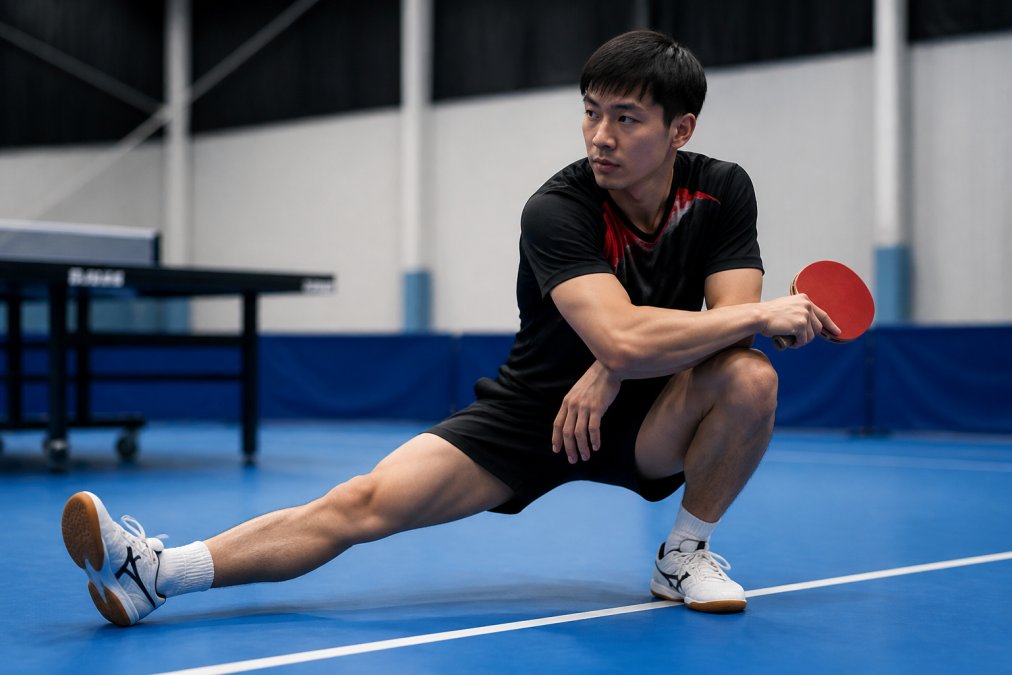
Here's a routine that covers the whole body in under 12 minutes:
- Two minutes of light cardio - jogging in place or jumping jacks to raise core temperature
- Arm circles and shoulder rolls - 30 seconds each direction to prep the rotator cuff
- Leg swings and hip openers - 10 reps per leg for hip and hamstring mobility
- Lateral shuffles - 30 seconds to activate the muscles that stabilize the knees
- Shadow footwork - 60 seconds of ghosting through forehand and backhand patterns
- Light rally - 2-3 minutes of slow hitting to groove timing before full speed
Dynamic Stretching vs. Static Stretching: What to Do Before You Play
Use dynamic stretching before you play and static stretching after. Dynamic movements like leg swings and walking lunges prepare muscles without reducing power output. Static holds of 20-30 seconds belong in your cool-down; holding one before play temporarily reduces muscle responsiveness.
Footwork, Stance, and Biomechanics: Building a Stable Base
Good biomechanics start with the stance: feet slightly wider than shoulder width, knees bent, weight on the balls of your feet, torso leaning forward from the hips. This base lets you move in any direction without losing balance or straining your back.
Footwork is where most recreational players lose their form. Use small, quick adjustment steps rather than big lunges: lunges put the knee past the toes and load the lower back with your full momentum, while small steps keep your center of gravity over your base.
Standing flat-footed between shots is a common mistake. Players who stay on their toes react faster and lower the cumulative load on the musculoskeletal system.
Ergonomic Shoe Selection for Court Surfaces
Court surface determines the right shoe. Indoor wooden or synthetic courts need a gum-rubber sole with a herringbone tread for grip and pivoting. Concrete or outdoor tables demand more cushioning, since hard surfaces transmit more shock through the knees and hips.
Look for a low, stable heel and a wide toe box: the low heel keeps you close to the ground for quick lateral movement, and the wide toe box prevents toe crowding that causes blisters and foot strain.
How to Pick Up Ping Pong Balls Without Bending (and Protect Your Back)
Learning how to pick up ping pong balls without bending is one of the highest-value injury prevention habits a player can build. Bending at the waist dozens of times per session is a leading cause of lower back pain, especially during multi-ball or robot training.
The fix is simple: use a ball pickup tool instead of your spine. A scoop-style collector gathers balls from a standing position, so your back never enters the loaded, rounded position that causes strain, especially valuable for coaches and players already managing back issues.
This is exactly the problem MyPingPongBuddy was built to solve. The handmade scoop collects balls with a simple standing motion, breaks down in half for transport, and is backed by a 90-day full refund return policy. One customer put it plainly: "I am absolutely amazed at how usable this little thing is!" For players with chronic back pain, it turns a painful chore into a non-event.
Equipment Matters: Racket Weight, Wristbands, and Grip
Racket weight and grip size directly affect how much stress your wrist, elbow, and shoulder absorb. A racket that's too heavy forces you to swing with your arm instead of your core; a grip that's too small makes you squeeze harder, a fast track to tendonitis.
Choose a racket weight that feels comfortable through a full session, not just the first five minutes. For most recreational players, a lighter blade with controlled rubber reduces strain without sacrificing much power.
A wristband does more than manage sweat: it keeps your hand dry so you maintain a relaxed grip, reducing forearm tension. Grip tape helps too if your handle feels slick.
Training Load Management and Recovery for Table Tennis Players
Training load is the total stress you place on your body across sessions, and managing it is the difference between steady progress and overuse injury. The rule is simple: increase volume gradually and build in recovery time.
How to Measure Your Load Without a Sports Scientist
You don't need wearable sensors. The simplest validated method is session-RPE: multiply training minutes by how hard it felt on a 1-10 scale. A 90-minute session rated a 6 equals 540 arbitrary units (AU). Add those up across a week for a weekly load number.
A common pattern among players who stay injury-free:
- Keep week-over-week increases under roughly 10%. Jumping from 1,500 AU to 2,500 AU in one week is the classic setup for tendon trouble.
- Alternate hard and easy days. A high-load multi-ball or robot session should be followed by a lighter technical or serve-practice day, not another max-effort session.
- Schedule a deload every fourth week. Cut volume by 30-40% while keeping intensity moderate. Tendons adapt more slowly than muscles, and the deload is when that adaptation catches up.
- Track soreness, not just volume. A daily 1-10 soreness rating for the lower back, knees, shoulder, and wrist will flag a brewing problem days before it becomes pain.
The Acute:Chronic Workload Idea, in Plain Terms
Sports-medicine practitioners compare your acute load (this week) to your chronic load (your rolling 4-week average). When the acute number spikes above the chronic baseline, injury risk rises. The practical takeaway: a sudden surge after a layoff is the danger zone. Coming back from two weeks off, start at roughly half your previous weekly load and rebuild over 2-3 weeks.
Recovery That Actually Moves the Needle
Recovery isn't passive, and not all habits are equal:
- Sleep is the highest-leverage recovery tool (peer-reviewed research). Most adults need 7-9 hours; athletes chasing adaptation often need the upper end. Chronic short sleep blunts tissue repair and reaction time.
- Cool-down: 5-10 minutes of easy movement followed by static stretching for the calves, hamstrings, hip flexors, and shoulders. Hold each 20-30 seconds.
- Hydration and fueling: even mild dehydration degrades focus and reaction time, which is itself an injury risk factor. Eat protein within a few hours of hard sessions to support tissue repair.
- Active recovery days: light walking, easy cycling, or a gentle rally keeps blood moving without adding meaningful load.
Off-Table Conditioning That Raises Your Load Tolerance
Physical conditioning off the table raises the ceiling on what your body can absorb. Prioritize:
- Core and anti-rotation work (planks, Pallof presses) to protect the lower back during rotational strokes.
- Single-leg strength and balance (split squats, single-leg balances) for knee and ankle stability during lateral footwork.
- Rotator-cuff and scapular work (band external rotations, rows) to counter the shoulder's forward, internally-rotated posture.
- Calf and hip mobility to keep the ankle and hip from dumping stress into the knee and back.
Return-to-Play: A Staged Progression
After any injury layoff, don't jump straight back into matches. A common staged approach:
- Pain-free daily activity, walking, stairs, no sharp pain.
- Light technical work, shadow footwork and slow rallies at low intensity.
- Progressive rallying, increase duration and intensity while monitoring symptoms.
- Full practice, multi-ball and match-like drills.
- Competition, only once full practice produces no next-day flare-up.
If pain returns at any stage, drop back a step rather than pushing through. A physiotherapist or sports-medicine clinician can tailor this progression to the specific tissue involved.
The single most important insight for injury prevention is that recovery is training. Players who schedule rest as deliberately as they schedule practice, and who track load instead of guessing, stay on the table far longer than those who don't.
First Aid and the PRICE Principle for Acute Injuries
The PRICE principle is the standard first-aid response for acute injury in table tennis: Protection, Rest, Ice, Compression, and Elevation. Apply it immediately after a sprain, strain, or sudden joint pain.
What You're Actually Treating
- Ankle sprain: a ligament stretch or tear, usually from rolling the ankle during lateral footwork. Expect swelling and bruising within hours.
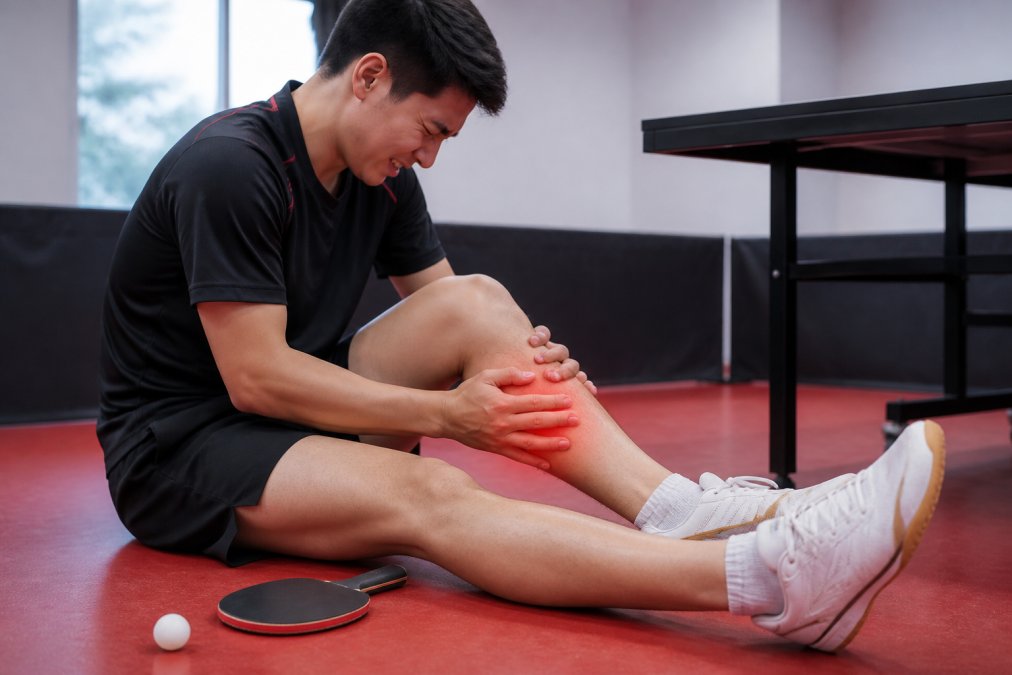
- Muscle strain: a tear in a muscle or its tendon, often the calf or hamstring from a sudden push-off. Pain is sharp and localized.
- Tendon flare (tendinopathy): an overuse reaction in the shoulder, elbow, or wrist. Usually builds gradually rather than appearing suddenly.
- Lower-back strain: muscle spasm or strain from a loaded, rounded bend, often during ball pickup or a low lunge.
Applying PRICE Correctly
- Protection, stop play immediately and guard the area from further stress. For an ankle, that may mean a brace or wrap before you put weight on it.
- Rest, avoid using the injured limb for the first 24-48 hours. "Rest" means relative rest, not total immobilization; gentle pain-free movement often helps.
- Ice, apply cold packs for 15-20 minutes every 2-3 hours during the first 48 hours. Always place a thin cloth between the pack and skin to prevent cold burns.
- Compression, wrap with an elastic bandage to limit swelling. It should feel snug but never numb, tingly, or discolored, if it does, loosen it.
- Elevation, raise the limb above heart level when possible, especially in the first 24-48 hours, to help fluid drain.
Ice vs. Heat: Getting the Timing Right
Use ice in the first 48 hours after an acute injury to reduce swelling and pain, and switch to heat only once swelling has settled and you're dealing with stiffness or tightness, heat too early can increase swelling. Simple rule: ice for fresh, swollen, hot injuries; heat for old, stiff, tight tissues.
Red Flags: When to See a Clinician
Most minor sprains and strains settle with PRICE and a gradual return. Seek medical care if you notice any of the following:
- You can't bear weight on the leg or use the arm at all.
- The joint looks deformed or feels unstable, like it might give way.
- Numbness, tingling, or loss of sensation below the injury.
- Swelling or pain that keeps worsening after 48 hours instead of improving.
- A pop or snap you felt at the moment of injury, especially with immediate swelling.
- No meaningful improvement after 1-2 weeks of self-care.
From First Aid to Rehabilitation
Self-treatment has limits. Once the acute phase passes, rehabilitation guided by a clinician prevents an acute problem from becoming chronic, progressing from pain-free range of motion to gentle strengthening, balance and proprioception work, and finally sport-specific loading. That last stage matters: the ankle must handle lateral shuffles, the shoulder repeated strokes, and the back the crouched stance before you return to full play.
Preventing the Next One
An acute injury is a signal, not just an accident. After you recover, review what led to it, a sudden jump in training load, worn-out shoes, poor footwork, or late-session fatigue, and fix the underlying cause so it doesn't return.
The table below summarizes the article's core prevention strategy at a glance.
| Risk Area | Prevention Habit | Why It Works |
|---|---|---|
| Lower back | Use a ball scoop, bend at knees | Removes repeated loaded bending |
| Knees | Dynamic warm-up, lateral shuffles | Builds stability and mobility |
| Shoulder and elbow | Lighter racket, relaxed grip | Reduces swing and grip strain |
| Wrists | Wristband, proper grip size | Keeps grip dry and loose |
| Overall load | Gradual volume increases, rest days | Lets tissue adapt and recover |
Frequently Asked Questions
What are the most common injuries in table tennis?
The most frequent table tennis injuries are lower back pain, knee strain, wrist tendonitis, and shoulder overuse. Lower back pain often stems from repetitive bending to pick up balls and poor stance during play. Knee issues arise from quick lateral movements on hard court surfaces. Wrist and shoulder problems develop from repetitive strokes without adequate strengthening. Using proper biomechanics, a solid warm-up routine, and tools that reduce bending can lower your risk significantly.
How can I prevent lower back pain while playing ping pong?
Preventing lower back pain starts with a dynamic warm-up that includes hip mobility and core activation. Maintain a slightly bent-knee stance rather than bending at the waist. Strengthen your core and lower back with exercises like planks and bird-dogs. Most importantly, reduce repetitive bending by using a ball picker like MyPingPongBuddy, which lets you scoop up balls without stooping. These steps address both acute strain and chronic overuse.
What warm-up exercises are best for table tennis?
A effective table tennis warm-up routine includes dynamic movements: arm circles, torso twists, leg swings, and light footwork drills like side-shuffles. Add shadow strokes without a ball to activate your shoulder and wrist. Spend 5-10 minutes on dynamic stretching before play, saving static stretches for after. This prepares your muscles and joints for the quick, rotational movements of the game, reducing injury risk.
When should I see a doctor for a table tennis injury?
See a doctor if you experience sharp pain that persists beyond 48 hours, swelling that doesn't improve with rest and ice, numbness or tingling in your arm or leg, or if you cannot bear weight on a joint. For chronic strains that linger more than two weeks despite rest, a medical evaluation can rule out tendonitis or stress fractures. Early intervention prevents minor issues from becoming long-term problems.
Injury prevention in table tennis comes down to respecting the sport's repetitive demands: warm up dynamically, move with small steps, manage your training load, and stop bending at the waist to chase balls. MyPingPongBuddy makes that last habit easy with a handmade scoop that collects balls from a standing position, breaks down for transport, and comes with a 90-day full refund return policy. Get started with MyPingPongBuddy and protect your back while you sharpen your game.