 ultimate-guide
How to Build a Home Table Tennis Club: Step-by-Step
Table of Contents
- Assess Your Space and Table Tennis Room Dimensions
- Select and Install Your Table Tennis Table
- Equip Your Club with Essential Gear and Table Tennis Ball Cleanup Tools
- Handle Legal Requirements and Liability Insurance
- Build Your Club Committee and Manage Finances
- Attract Members and Market Your Club
- How to Organize a Table Tennis Tournament
- Maintain Your Club and Build Community
- Frequently Asked Questions
Last Updated: October 1, 2026
Assess Your Space and Table Tennis Room Dimensions
Building a home table tennis club starts with honest assessment of your available space. A regulation table tennis table measures 9 feet long by 5 feet wide. Add minimum clearance of 3 feet on each end and 2 feet on each side, requiring roughly 15 feet by 9 feet for a single table. A two-table setup needs approximately 30 feet by 9 feet.
Competitive play demands at least 9 feet of ceiling clearance. Lower ceilings restrict player trajectories and limit training effectiveness. Wood flooring is preferable to concrete because it absorbs impact and reduces noise; carpet is problematic as it affects ball bounce unpredictably. Climate control between 65°F and 75°F prevents equipment warping and keeps players comfortable. Assess your space honestly before purchasing equipment, a cramped facility discourages members from returning.
Select and Install Your Table Tennis Table
Choosing the right table is your largest equipment investment and determines whether your facility feels professional or makeshift.
Full-size tables (9' × 5') are standard for competitive play. 3/4 size tables (7' × 4') work for smaller spaces or beginners, but experienced players notice the difference and may avoid your facility. Look for composite wood surfaces at least 25mm thick; thinner surfaces wear quickly under heavy use. The playing surface should be matte to prevent glare and maintain consistent ball response.
Examine hinges carefully, quality hinges should be metal, not plastic. The table must sit perfectly level when unfolded; a rocking table ruins every match. Use a basic level tool to verify during installation. An unlevel table creates systematic bias and unpredictable ball movement.
Equip Your Club with Essential Gear and Table Tennis Ball Cleanup Tools
Equipment beyond the table determines whether your club operates smoothly or devolves into frustration.
Rackets and Balls
Stock quality rackets for members who forget their own. Keep at least 4-6 club rackets available. Balls wear out quickly under heavy use; plan to replace them monthly. Standard white balls (40mm) are regulation.
Nets, Posts, and Lighting
A net and post set must adjust to regulation height (6 inches at edges, 6.1 inches at center). Invest in a quality net system that stays taut and survives frequent adjustments.
Lighting makes or breaks playability. Overhead fluorescent lights create glare and make the ball difficult to track. LED panels mounted above and slightly behind the tables eliminate glare while providing even, bright illumination. Budget for proper lighting before anything else beyond the table itself.
Ball Collection and Storage Solutions
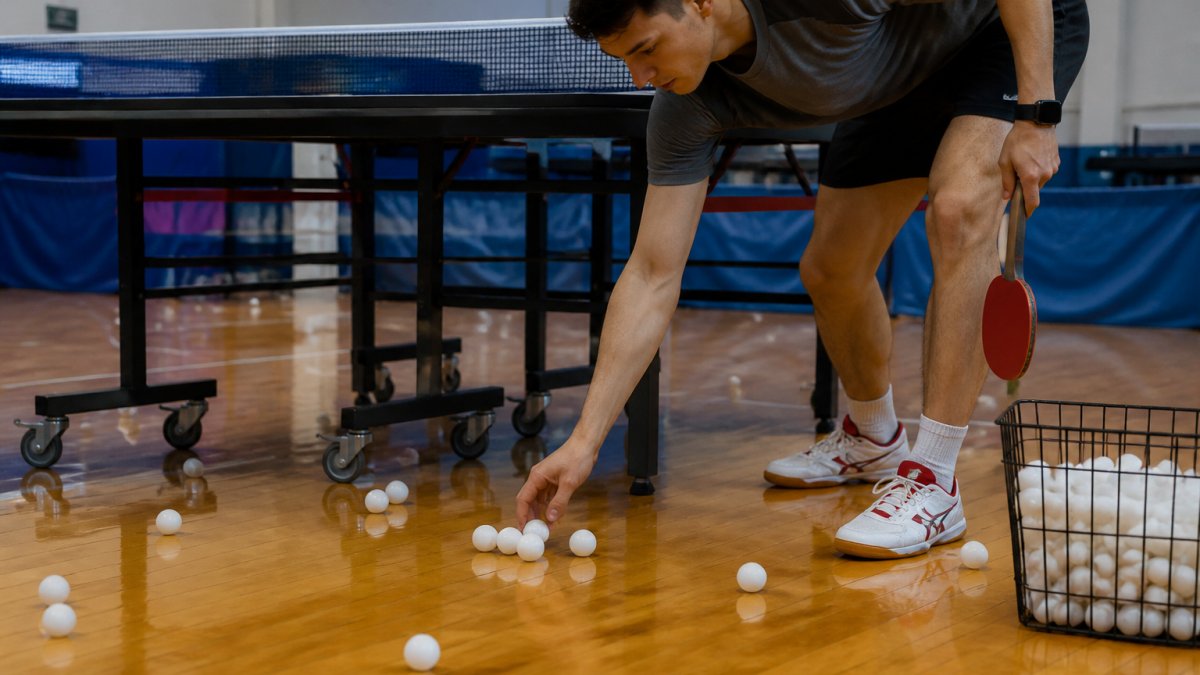
Ball cleanup is the operational reality most guides skip entirely. During a busy session, balls scatter constantly. MyPingPongBuddy's handmade ball scoop tool solves this problem directly. It allows players to scoop up multiple balls at once without bending, which matters enormously for clubs with high volume or members with back issues. The tool breaks down in half for transport, making it practical even in tight spaces. Used by clubs and SPIN in NY, Milwaukee and LA, it eliminates the repetitive strain that discourages both casual players and serious coaches from maintaining their own setups.
Store collected balls in mesh bags or open bins, never sealed containers that trap moisture.
Handle Legal Requirements and Liability Insurance
This section separates professional clubs from informal gatherings and protects your personal assets.
Legal Entity Formation
Decide whether to operate as a sole proprietorship, partnership, or formal entity (LLC or nonprofit). A sole proprietorship exposes your personal assets if someone is injured and sues. An LLC (Limited Liability Company) costs $50-$300 to form depending on your state and provides liability protection, your personal home and savings are shielded if a member is injured at the club. Most home clubs choose an LLC for this reason.
File Articles of Organization with your state's Secretary of State office. Processing takes 1-3 weeks. Once approved, you receive an EIN (Employer Identification Number) from the IRS for the club's bank account and tax filings.
Liability Insurance and Coverage
General liability insurance is mandatory. Standard homeowner's policies explicitly exclude business activities, your homeowner's insurance will deny claims for club-related injuries. A dedicated liability policy costs $300-$800 per year for a small home-based club. This covers bodily injury, property damage, and legal defense costs if you're sued.
When shopping for insurance, specify that the policy covers "table tennis instruction and recreational play" at a home-based facility. Get quotes from at least three providers. Most clubs carry $1 million in general liability coverage, which is standard for recreational facilities.
Liability Waivers and Member Agreements
Require every member to sign a liability waiver before their first session. A waiver does not eliminate your legal responsibility, but it demonstrates that members understood the inherent risks and agreed to assume them. Consult a local attorney to draft or review your waiver ($150-$400 for a one-time review). An attorney ensures your waiver complies with your state's laws and includes language that holds up in court.
Your waiver should include acknowledgment that table tennis involves risk of injury, agreement that the member assumes all risks, release of liability for the club and other members, confirmation that the member is physically able to participate, and agreement to follow club safety rules.
Safety Protocols and Documentation
Write down your safety rules and post them visibly. Your safety protocols should cover footwear (no open-toed shoes or sandals), ball management (designated collection procedures), table inspection (members report damage immediately), hydration and breaks, supervision requirements for beginner or youth sessions, and equipment maintenance standards.
Zoning and Municipal Permits
Check whether your municipality requires permits or has zoning restrictions on home-based businesses. Call your local zoning office and describe your club. Zoning restrictions vary widely; some allow home-based clubs with no permit, others require a conditional use permit or home occupation license ($50-$200, renewed annually).
Tax Considerations
Once you have an EIN, you must file annual tax returns for the club, even if it operates at a loss. Keep detailed records of all income (membership fees) and expenses (table maintenance, equipment, insurance, utilities). A simple spreadsheet or accounting software (QuickBooks Self-Employed, Wave) is sufficient for most home clubs and costs $0-$200 per year.
Build Your Club Committee and Manage Finances
A club survives on structure, not enthusiasm. A three-person committee works for most home clubs: a coordinator (handles scheduling and member communication), a treasurer (manages finances and membership fees), and an equipment manager (maintains tables, nets, and balls). Rotate roles annually to prevent burnout.
Attract Members and Market Your Club
Your home table tennis club succeeds only if people know it exists and want to join.
How to Organize a Table Tennis Tournament
Tournaments create excitement and give members a reason to commit seriously to the club.
Setting Tournament Structure and Skill Levels
Organize tournaments by skill level: beginner, intermediate, and advanced. This ensures competitive matches where players have realistic chances of winning. Round-robin formats work well for small clubs (8-16 players per division). Each player faces every other player once; the player with the best record wins.
Scheduling and League Play
Schedule tournaments during times when most members can attend. Weekend afternoons work better than weekday evenings. Announce tournaments at least two weeks in advance.
Maintain Your Club and Build Community
Long-term success depends on maintenance discipline and deliberate community-building systems.
Equipment Maintenance Systems
Check tables monthly for warping, surface cracks, or edge damage. Wipe down playing surfaces weekly to remove dust. Replace nets when they show wear. Inspect balls regularly; discard ones that no longer bounce consistently.
Member Retention Through Structured Engagement
Retention is harder than acquisition. Most home clubs lose 30-40% of members within the first three months because they fail to build belonging.
Community Building Beyond Tournaments
Skill clinics. Schedule monthly clinics where advanced players teach specific techniques. These are free for members and position your club as a learning community.
Retention Metrics and Adjustments
Track membership churn (the percentage of members who leave each month). If churn exceeds 15% per month, something is wrong. If churn is below 5%, your retention systems are working.
Facility Maintenance and Member Experience
Small details signal whether your club is professional or amateur: keep the facility clean, ensure adequate lighting, maintain comfortable temperature (65-75°F), stock basic supplies (towels, water, trash bins, first aid kit), and fix problems immediately. A well-maintained facility signals that you respect members' time and experience, which builds loyalty.
Frequently Asked Questions
What are the minimum space requirements for a home table tennis club?
A regulation table tennis table is 9 feet long and 5 feet wide. Allow at least 7 feet of clearance on each end and 4 feet on each side for play. For multiple tables, multiply these dimensions accordingly. Total room size depends on how many tables you plan to set up, a single-table setup needs roughly 20 feet by 15 feet, while clubs with multiple tables require significantly more space. Ceiling height should be at least 10 feet to accommodate high shots.
Why should I use table tennis ball cleanup tools instead of picking up balls by hand?
Ball cleanup tools save time and reduce strain on your back, especially during high-volume training sessions. Instead of bending repeatedly to collect hundreds of balls, you can scoop them efficiently while standing. This is particularly important for coaches running multi-ball drills, players with back issues, and facility managers maintaining multiple tables. Quality tools like those from MyPingPongBuddy help keep your focus on training rather than cleanup.
How do I structure leagues and tournaments for my home club?
Start by dividing members into skill levels, beginner, intermediate, and advanced. Create a round-robin format for regular league play where each player faces others in their skill bracket over several weeks. For tournaments, use single-elimination or double-elimination brackets depending on participation. Schedule matches at consistent times, track results, and rotate skill brackets periodically to keep competition fresh. Many clubs run monthly tournaments and weekly open play sessions to balance competitive and casual members.
What liability insurance do I need for a home table tennis club?
Contact your homeowners or renters insurance provider to discuss adding a liability rider for club activities on your property. You may also consider general liability insurance if members pay membership fees. Ensure your policy covers injuries sustained during play and training. Consult with an insurance agent about the specific coverage limits needed based on your club's size and activity level. Having clear liability protection protects both you and your members.