 how-to
Improve Table Tennis Without a Partner: Solo Training Guide
Table of Contents
- Can You Improve Table Tennis Without a Partner?
- Table Tennis Drills Without a Partner
- Table Tennis Serve Practice Drills for Beginners
- Table Tennis Practice Without a Table
- Table Tennis Robot Training for Solo Development
- Building a Progressive Solo Training Plan
- Frequently Asked Questions
Last Updated: October 10, 2026
Can You Improve Table Tennis Without a Partner?
Yes, you can improve table tennis without a partner. Solo practice builds consistency, technique, and mental toughness.
Many players assume they need constant rallies to improve. That's not entirely true.
Structured solo practice can be highly effective, with purposeful repetition and clear goals making a significant difference in improvement.
Here's what solo practice does well: it builds muscle memory, improves footwork, develops serve accuracy, and strengthens your mental game.
The bottom line: you can improve table tennis without a partner, but you need a plan. Random solo practice won't cut it.
Table Tennis Drills Without a Partner
Solo drills are the foundation of improvement. The best ones target specific skills and demand repetition. Three methods dominate: shadow play, wall practice, and rebound boards.
Shadow Play and Stroke Mechanics
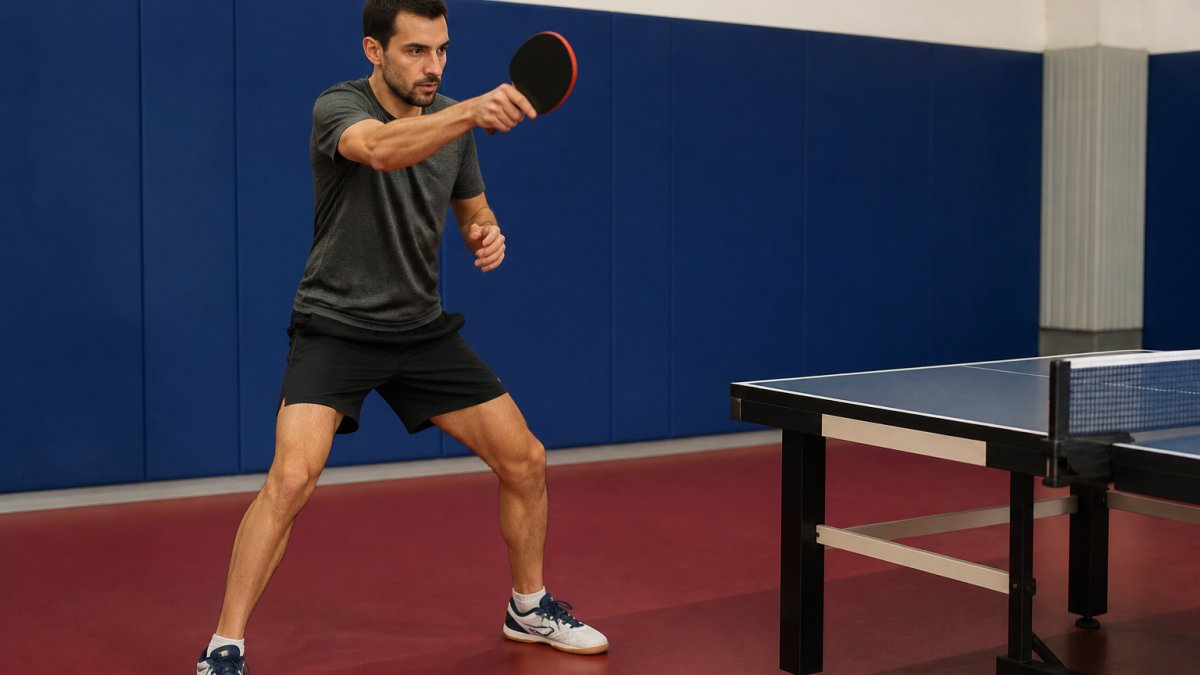
Shadow play means practicing strokes without a ball. You move through your ready position, footwork, and complete stroke cycles. It sounds simple. It's actually one of the most effective solo training methods.
Why shadow play works:
- Builds muscle memory without worrying about ball control
- Lets you focus on footwork and balance
- Trains your body's timing and rhythm
- Takes zero equipment
Start with your ready position. Feet shoulder-width apart, knees bent, weight on the balls of your feet. From there, practice forehand loops, backhand drives, and serve motions in slow motion.
Most players rush shadow play. They do a few strokes and move on. Real benefit comes from doing 50-100 repetitions per session. Your muscles need to groove the pattern.
Wall Practice and Rebound Boards
Hitting against a wall or rebound board gives you feedback. The ball comes back. You hit again.
Wall practice teaches:
- Ball control and consistency
- Placement accuracy
- Reaction time
- Rally building
Find a smooth wall or use a rebound board (a tilted surface that bounces balls back). Stand about 8-10 feet away. Hit forehands, backhands, and mixed strokes.
The challenge: wall practice doesn't teach you to handle spin. The ball comes back flat. Real opponents hit topspin, backspin, and sidespin.
Rebound boards work better than walls because they angle the ball back more like a table would. Some boards have different zones for different spin levels.
Table Tennis Serve Practice Drills for Beginners
The serve is the one shot you control completely. No opponent. No variables. This makes it the perfect solo skill to master.
Serve Toss and Ball Contact Timing
A consistent serve starts with a consistent toss. Many beginners struggle here because the toss and contact point are separate skills.
Practice your toss first:
- Toss the ball straight up from your palm
- Let it rise 6-8 inches above your head
- Catch it in the same spot 10 times in a row
- Do this without a paddle
Once your toss is solid, add the paddle. Focus on hitting the ball at the peak of its rise. Contact point matters more than swing speed. A clean hit at the right moment beats a hard swing at the wrong moment.
Perform 20-30 serves per session, focusing on the same serve type. Consistency comes from repetition, not variety. Master one serve before moving to the next.
Serve Placement and Spin Variations
Once your basic serve is solid, work on placement. Set targets on the table: short serves near the net, long serves near the baseline, wide serves toward the sidelines.
Start with no spin. Just placement. Hit 10 serves to each target zone. Track how many land in. Then add topspin, backspin, or sidespin.
Spin variations you can practice alone:
- Topspin serves: brush the ball upward
- Backspin serves: brush downward
- Sidespin serves: brush left or right
- Combination spins: mix topspin with sidespin
Practice one spin type for 10 serves, then switch. This builds variety and muscle memory.
Table Tennis Practice Without a Table
No table? You can still train. Shadow play works anywhere. Wall practice works in gyms or parks. You lose some feedback, but you don't lose progress.
Many players practice footwork drills without any equipment:
- Lateral shuffles: move side to side quickly
- Forward-backward sprints: practice approach steps
- Diagonal movements: work on court coverage
- Balance drills: hold positions and practice weight shifts
These drills build the movement patterns that matter in rallies. Speed and positioning often matter more than stroke technique.
You can also use a makeshift setup. A garage wall, a park wall, or even a fence works for ball practice. The ball doesn't need to be table height. Solo practice is about building habits, not playing matches.
Table Tennis Robot Training for Solo Development
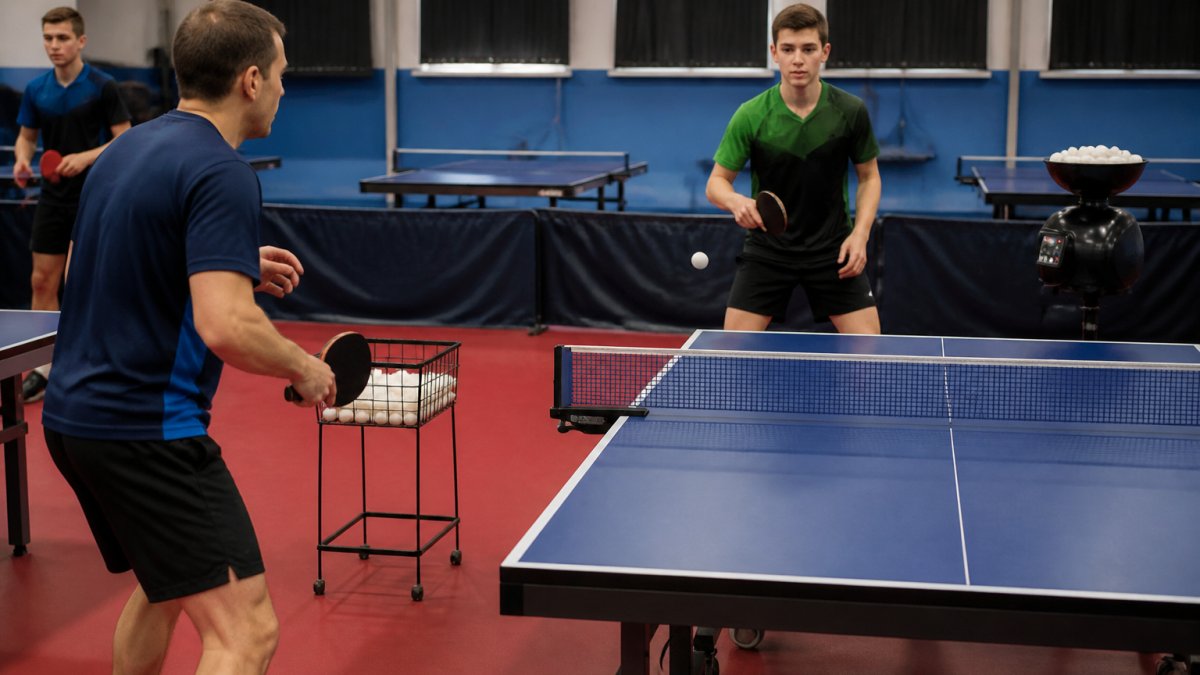
A ball machine or robot automates feeding. The machine shoots balls at consistent speed, spin, and placement. You hit them.
Robots excel at:
- Repeating the same ball setup
- Building consistency through high-volume practice
- Developing footwork under pressure
- Testing different stroke types
The downside: robots are expensive. Entry-level machines start at several hundred dollars. They also take up space and require electricity.
If you have access to a robot, use it for specific drills. Don't just hit balls. Program a sequence: 10 balls to your forehand, 10 to your backhand, 10 mixed. Track how many you make. Robots force accountability.
Many clubs have robots. Ask if you can book time. It's cheaper than buying one and still gives you the benefits.
Building a Progressive Solo Training Plan
Random practice doesn't build skill. A plan does. The difference between players who improve and those who plateau is intentional progression, knowing when to advance, when to repeat, and how to measure each phase.
Phase-Based Structure with Clear Benchmarks
Organize your solo training into four overlapping phases. Each phase has a focus, daily time commitment, and measurable success criteria. Progress only when you hit the benchmark; don't move forward just because time has passed.
Phase 1: Fundamentals (Weeks 1-4)
- Focus: Shadow play, basic serve consistency, ready position
- Daily commitment: 15 minutes shadow play, 20 serves
- Key drills:
- Shadow play: 50 repetitions each of forehand loop, backhand drive, and serve motion (slow, controlled)
- Serve toss: 10 consecutive catches in the same spot without a paddle
- Basic serve: 20 attempts to a target zone (short or long), no spin
- Success benchmarks:
- Toss consistency: 8 out of 10 catches in the same spot
- Serve accuracy: 14 out of 20 serves land in the target zone
- Form check: Record shadow play; strokes should show smooth, complete follow-through
- Adjustment: If you're not hitting benchmarks after 2 weeks, repeat that week. Do not advance until benchmarks are met.
Phase 2: Wall and Placement (Weeks 5-8)
- Focus: Rally consistency, serve placement variety, footwork under ball pressure
- Daily commitment: 20 minutes wall play, 30 varied serves
- Key drills:
- Wall rallies: Hit forehands and backhands against a wall or rebound board, aiming for 20+ consecutive hits
- Serve placement: 10 serves to each of three zones (short, mid, long); track accuracy
- Footwork: Lateral shuffles between wall hits; move 2-3 feet side to side with each shot
- Success benchmarks:
- Wall consistency: 20+ consecutive hits without missing
- Serve placement: 7 out of 10 serves land in each target zone
- Footwork: Complete 5 lateral shuffle sequences (10 shuffles each) without losing balance
- Adjustment: If wall consistency stalls below 15 hits, reduce speed and focus on control. If serve placement is below 6/10, slow down and emphasize target aiming over spin.
Phase 3: Spin and Variety (Weeks 9-12)
- Focus: Spin control, mixed-stroke sequences, serve deception
- Daily commitment: 25 minutes wall play with spin, 40 serves with spin variation
- Key drills:
- Topspin wall practice: Hit 10 topspin forehands, 10 topspin backhands, then 10 mixed
- Backspin serves: 10 backspin serves to each zone (short, mid, long)
- Sidespin serves: 10 sidespin serves to each zone
- Mixed sequences: Alternate forehand, backhand, and footwork movement for 30 consecutive hits
- Success benchmarks:
- Topspin consistency: 15+ consecutive topspin hits on the wall
- Spin serve accuracy: 6 out of 10 backspin and sidespin serves land in target zones
- Mixed sequences: 30+ consecutive mixed strokes without missing
- Adjustment: If spin control is weak, reduce wall distance by 1-2 feet. If serve spin is inconsistent, practice 5 slow-motion serves before speed drills.
Phase 4: High Volume and Match Simulation (Weeks 13+)
- Focus: Endurance, speed, fatigue resistance, decision-making
- Daily commitment: 30+ minutes mixed drills, 50+ serves
- Key drills:
- Extended wall rallies: Aim for 50+ consecutive hits
- Serve sequences: Hit 50 serves in a single session, varying spin and placement
- Footwork circuits: Combine lateral shuffles, forward-backward sprints, and diagonal movements for 10 minutes
- Pressure serves: Hit 20 serves in a row; track percentage made (simulate match pressure)
- Success benchmarks:
- Wall consistency: 50+ consecutive hits
- Serve accuracy under fatigue: 16 out of 20 serves in target zones after 30 minutes of practice
- Footwork speed: Complete footwork circuit 3 times without form breakdown
- Adjustment: If fatigue drops your serve accuracy below 14/20, add 2-3 minute rest intervals. If wall consistency drops, reduce target distance.
Measuring Progress Without a Coach
You need metrics. Without a coach watching, track these four categories in a simple log (spreadsheet or notebook):
1. Serve Accuracy
- Test: Hit 50 serves of the same type to a target zone
- Track: Number made out of 50 (aim for 70%+ by Phase 3)
- Frequency: Test once per week
- Example log entry: "Week 6, Tuesday: Backspin serves, short zone. 38/50 = 76%. ✓ Benchmark met."
2. Rally Consistency (Wall or Rebound Board)
- Test: Hit continuously against wall; count consecutive hits before missing
- Track: Best streak per session, average streak
- Frequency: Every session
- Example: "Week 8, Thursday: Wall rallies. Best streak: 34 hits. Avg: 22 hits. ✓ Progressing."
3. Footwork Speed
- Test: Time yourself on a lateral shuffle drill (10 shuffles left, 10 right = 1 rep; do 5 reps)
- Track: Total time for 5 reps
- Frequency: Once per week
- Example: "Week 10, Monday: Lateral shuffles. 5 reps in 18 seconds. (Previous week: 20 sec.) ✓ Faster."
4. Serve Variety Under Fatigue
- Test: After 20 minutes of wall play, hit 20 serves with mixed spins (5 topspin, 5 backspin, 5 sidespin, 5 no-spin)
- Track: Total makes out of 20
- Frequency: Once per week
- Example: "Week 12, Saturday: Mixed serves after fatigue. 16/20 = 80%. ✓ Benchmark met."
Video Self-Assessment
Record yourself once every two weeks. Focus on:
- Serve: Is your toss consistent? Does your contact point stay the same?
- Shadow play: Are your strokes complete? Do you finish your follow-through?
- Wall play: Are you moving your feet, or just using your arm?
Compare week-to-week video. You'll spot form issues a coach would catch: early contact, incomplete follow-through, static footwork. Slow-motion playback reveals timing problems invisible at normal speed.
When to Repeat a Phase vs. Advance
Do not advance to the next phase until you hit at least 3 out of 4 benchmarks for 2 consecutive weeks. If you hit only 2 out of 4, repeat the phase for another week and retest.
Example:
- Week 4: Hit 3/4 benchmarks
- Week 5: Hit 3/4 benchmarks → Advance to Phase 2
- Week 6: Hit 2/4 benchmarks → Repeat Week 5 drills
- Week 7: Hit 4/4 benchmarks → Advance to Phase 2
This prevents false progress and ensures your foundation is solid before adding complexity.
Frequently Asked Questions
Can you really improve table tennis without a partner?
Yes, you can improve table tennis without a partner, though solo practice has limits. Shadow play, serve practice, footwork drills, and wall training build stroke mechanics, timing, and consistency. However, rally skills and tactical decision-making develop best with opponents. A balanced approach combining solo drills with occasional partner play yields the fastest progress.
What solo drills improve table tennis footwork?
Footwork improves through shadow play, where you move through ready positions and strokes without a ball, and side-to-side shuttle drills near the table. Practice explosive first steps, recovery steps, and balanced positioning. Wall practice also strengthens footwork by requiring constant adjustment to ball returns. Aim for 10-15 minutes of focused footwork work per session.
How can beginners practice table tennis serves by themselves?
Beginners should focus on serve toss consistency first, tossing the ball repeatedly to the same height without hitting it. Then practice serve contact point and follow-through. Use a wall or rebound board to check serve placement and spin. Practice 20-30 serves daily, rotating between topspin, backspin, and flat serves. Track placement accuracy by targeting specific wall zones.
Can a table tennis robot help you practice alone?
Yes, table tennis robots are excellent solo training tools. They provide consistent, adjustable ball feeds for developing stroke mechanics, footwork, and rally consistency. Robots let you practice specific shots repeatedly and control spin, speed, and placement. However, they cannot replicate opponent tactics or require you to read and react to varied shots, so supplement robot training with wall practice and shadow play for well-rounded development.