
 listicle
Best Training Aids for Ping Pong Clubs: 2026 Guide
Table of Contents
- Quick Comparison: Top Training Aids for Ping Pong Clubs
- How We Evaluated These Ping Pong Training Aids
- Training Robots: Automated Multi-Ball Feeding Systems
- Ping Pong Ball Collection Tools for High-Volume Clubs
- Table Tennis Footwork Training Equipment and Return Boards
- Table Tennis Serve Practice Drills for Beginners: Aids That Help
- Training Balls and Durability for Club Sessions
- Maintenance and Longevity: Protecting Your Club Investment
- Frequently Asked Questions
Last Updated: September 14, 2026
Quick Comparison: Top Training Aids for Ping Pong Clubs
Finding the best training aids for ping pong clubs starts with matching equipment to how your facility actually runs sessions. A 15-table club needs different tools than a coach running one robot drill station. This guide from MyPingPongBuddy breaks down the equipment that survives daily club use, from multi-ball robots to collection tools that save your back.
Below, we compare robots, ball collectors, footwork systems, and durability essentials, with the practical detail club managers need before spending.
| Training Aid | Category | Best For | Key Spec |
|---|---|---|---|
| MyPingPongBuddy | Ball collection | Daily club cleanup, back-pain relief | Handmade, breaks in half for transport |
| Butterfly Amicus Professional | Multi-ball robot | Professional clubs, competitive players | Programmable sequences, variable spin |
| Power Pong Omega | Multi-ball robot | Coaches programming drills | Tablet-controlled via Bluetooth |
| Pongbot Omni S Pro | Multi-ball robot | Mid-sized clubs | Dual-wheel spin, adjustable oscillation |
| Ball Collection Net System | Court containment | High-volume robot sessions | Side nets, durable mesh |
| FastPong Training System | Footwork and reaction | Speed and placement drills | LED targets, performance tracking |
| HURRISE Trainer | Serve and stroke practice | Beginners | Spring-loaded shaft, weighted base |
| JOOLA Training 3-Star | Training balls | Multi-ball sessions | 40+mm ABS, bulk packaging |
How We Evaluated These Ping Pong Training Aids
We judged every product on durability under repeated daily use, space efficiency in shared club environments, and teaching value for coaches. A tool that works for one home player but fails after a week of club sessions did not make this list.
Three criteria carried the most weight:
- Build quality: Materials and construction that hold up to hundreds of balls per session
- Setup and storage footprint: How much floor space it occupies and how fast it breaks down between bookings
- Coaching utility: Whether it supports structured drills, not just casual hitting
We also factored in maintenance demands. Equipment that needs constant repair quietly drains a club's budget, so we favored tools with simple, serviceable designs.
Training Robots: Automated Multi-Ball Feeding Systems
Multi-ball training robots are the backbone of serious club sessions, feeding balls at consistent speed and spin so players repeat strokes without a partner. For a club, the buying decision is not "which robot is best", it is "which robot survives a 40-hour week, fits the room, and can be programmed fast enough to keep a group moving." Match the robot to your coaching model and your facility's constraints before you spend.
What Actually Separates Club Robots
Four specs matter more than marketing bullet points:
- Duty cycle and motor cooling. A robot rated for home use may overheat under back-to-back group sessions (Machine Safety Standards). Look for a stated continuous-run rating and a cooling fan, and plan a short cooldown between long feeds.
- Ball capacity and feed reliability. Larger hoppers (typically 100-200 balls) mean fewer refill interruptions. A club running six players through a drill station will refill a small hopper several times per session.
- Programming interface. Remote, tablet, or onboard controls change how fast a coach can switch drills. If the coach is also spotting technique, one-touch drill recall matters.
- Serviceability. Ask whether wheels, feed belts, and the power supply are user-replaceable and whether parts ship domestically. A robot that must be shipped out for repair takes a station offline for weeks.
Butterfly Amicus Professional
The Amicus Professional is the benchmark for programmable drills, with remote-controlled spin, speed, and trajectory settings. It suits professional clubs and competitive players who need realistic ball delivery for complex sequences. The one drawback is the high upfront investment.
Club angle: The Amicus line is widely used in academy settings, and its remote makes it practical for a coach standing at the table correcting a player rather than walking back to the unit. Budget for a spare set of wheels and a backup power supply so a single failure does not idle the station.
Power Pong Omega
A tablet-based Bluetooth interface makes the Omega the easiest robot to program on this list. Its three-wheel head produces varied spin combinations, and pre-loaded drills get a session running fast. It fits coaches who want quick setup. The catch: it requires an external tablet.
Club angle: Because the drill library lives on the tablet, keep a dedicated club tablet charged and locked to the app. This is the robot to choose if your coaches rotate and you want any of them to run the same drill without relearning the interface.
Pongbot Omni S Pro
For mid-sized clubs, the Omni S Pro balances features and price. Dual-wheel spin variation and adjustable oscillation support footwork drills, and the compact body stores easily. It is less programmable than the top-tier models, which matters if you run advanced sequences.
Club angle: The lower price makes it realistic to run two or three units as parallel drill stations, which raises throughput for group sessions far more than one premium robot would.
Power, Space, and Placement in a Shared Room
Before ordering any robot, confirm three facility facts:
- Power. Most units run on standard household current, but a multi-station setup can overload a single circuit (osha.gov). Spread stations across outlets and avoid daisy-chaining power strips.
- Floor space. A robot needs clearance behind the table for the ball stream and a safe zone so players do not back into it. Side nets (covered below) contain the spray.
- Storage. Robots are heavy and awkward to move. A locking cabinet or dedicated shelf near the table beats hauling units across the room between bookings.
Programming Group Drills, Not Just Solo Feeds
A robot earns its keep when it drives a structured session. A common pattern for a group station:
- Warm-up block (5 min): one consistent topspin feed to one corner, players rotate every 20 balls.
- Footwork block (10 min): oscillating feed across two or three zones, forcing lateral movement.
- Spin-reading block (10 min): alternate backspin and topspin so players learn to adjust.
- Pressure block (5 min): random placement at match pace.
Save each block as a preset so any coach can recall it. This is the difference between a robot that collects dust and one that anchors your curriculum.
Ping Pong Ball Collection Tools for High-Volume Clubs
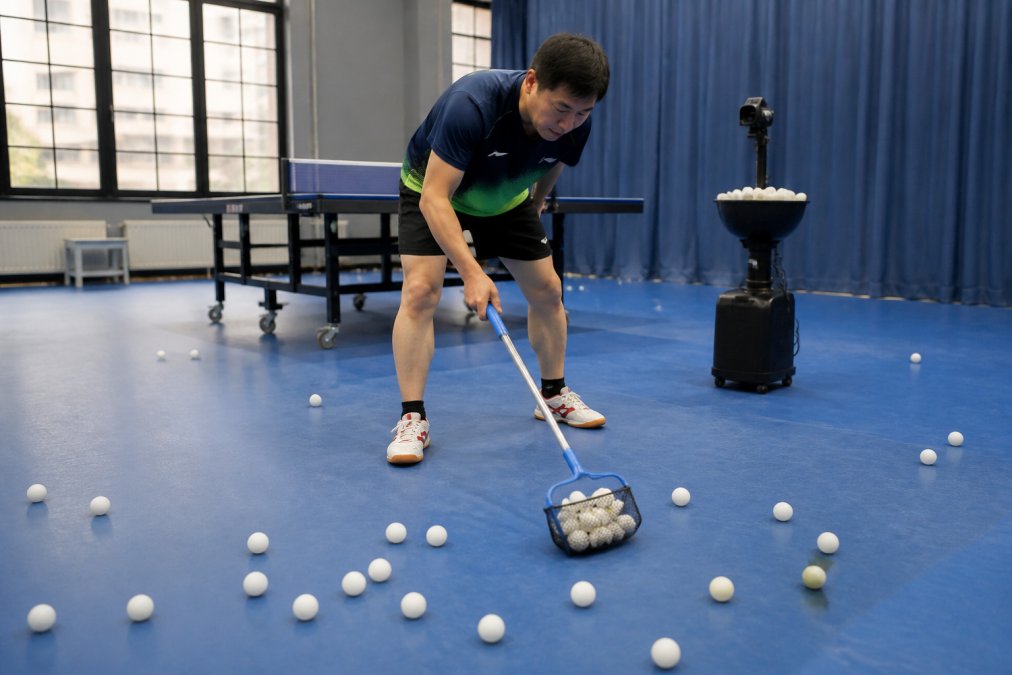
Ball collection is where most clubs lose time and where coaches lose their backs. A 15-table facility can scatter hundreds of balls per session, and bending to gather them one by one adds up to real fatigue (osha.gov). The club-specific problem competitors skip is scale: you are not collecting one hopper's worth of balls, you are collecting across multiple courts, multiple times a day, with staff who may not be the same person each shift.
The Labor Math That Justifies the Purchase
Think in minutes, not dollars. If a coach spends even a few minutes per session gathering balls by hand, multiply that across every session, every court, every day of the week. A tool that shaves those minutes pays for itself quickly in recovered coaching time and reduced strain injuries. This is the argument to bring to a club owner who balks at the price of a scoop or net system.
MyPingPongBuddy: Handmade Scoop for Daily Club Use
MyPingPongBuddy is a handmade scoop that collects balls without bending, and it breaks in half for transport between courts and storage rooms. It is our top pick for clubs because it addresses the two biggest cleanup problems at once: back strain and time. Coaches report students prefer it to net scoopers because they pick up balls faster, and it is issued as a prize at the Huntsman World Senior Games. A 90-day full refund policy backs the purchase.
Club angle: The two-piece design is the feature that matters most in a shared facility. A single scoop can be split between two staff members working opposite ends of a room, and the halves store in a drawer rather than leaning against a wall where they get knocked over.
Table Tennis Ball Collection Net Systems
Floor-standing net systems attach to the table and catch angled shots during robot or multi-ball practice, cutting cleanup dramatically. They suit high-volume sessions. The trade-off is footprint: side nets take up space around the table.
Club angle: Nets shine specifically at robot stations, where balls spray in a predictable arc. Pair a net with a robot and you contain most of the spray at the source, then finish with a scoop. On open play tables with no robot, nets add clutter without catching much.
Building a Collection Workflow for Multiple Courts
A single tool rarely solves a whole facility. A repeatable club workflow looks like this:
- Contain at the source: nets around robot and multi-ball stations.
- Sweep between rotations: a scoop or roller per court so balls are gathered before the next group sits down.
- Centralize: one large bin per room where collected balls are dumped, counted, and redistributed to hoppers.
- Assign ownership: make ball collection a named duty in each session plan so it does not fall to whoever is closest.
Storage and Durability in a High-Traffic Room
Collection tools take more abuse than any other aid in a club because they are handled constantly and stored carelessly. Two habits extend their life:
- Dry storage. Mesh and fabric components rot or mildew if stored damp. Hang nets and bags rather than piling them in a closet.
- Designated homes. Give every scoop, roller, and net a labeled spot. Tools without a home get stepped on, bent, or lost.
Table Tennis Footwork Training Equipment and Return Boards
Footwork and reaction training separates clubs that develop players from those that just host games. The right equipment forces lateral movement and quick decisions, which is hard to replicate in casual rallies.
FastPong Training System
FastPong uses LED targets to train placement and reaction speed, with performance-tracking software and multiple game modes. It fits clubs focused on speed and accuracy. Its limitation is scope: it covers reaction drills, not full stroke development.
Return Boards and Rebounders
Rebounders send balls back for solo repetition, ideal for players drilling stroke mechanics without a partner. They are compact and beginner-friendly, though they cannot simulate true ball trajectory the way a robot does.
Table Tennis Serve Practice Drills for Beginners: Aids That Help
Beginners need repetition, and serve practice drills for beginners work best with tools that return the ball predictably. A trainer that holds up to daily use lets new players build consistency before they join live drills.
HURRISE Table Tennis Trainer
The HURRISE trainer uses a spring-loaded shaft and weighted base for solo stroke and serve practice. It is an affordable way to build hand-eye coordination. It does not simulate real ball trajectory, so treat it as a supplement, not a substitute for live play.
Training Balls and Durability for Club Sessions
Training balls are consumables, and clubs burn through them fast during multi-ball and robot sessions. Durability and consistent bounce matter more than tournament certification for daily practice.
JOOLA Training 3-Star Balls
JOOLA's 40+mm ABS balls hold up well under robot use. Consistent weight and roundness make them reliable for repetitive drills. They are a consumable, so budget for regular replacement.
MAPOL Training Balls
MAPOL sells 100-count bulk packs, aimed at coaches running large group drills. The high-visibility white color helps in busy halls. They are not suitable for official tournament play, which is fine for practice.
Maintenance and Longevity: Protecting Your Club Investment
Robots and collection tools last years when maintained, and fail early when ignored. Cleaning rubber and wheels, replacing worn balls, and storing equipment dry are the habits that stretch a club budget.
- Wipe robot wheels with a rubber cleaner after heavy sessions
- Replace edge tape and grip tape before they fray
- Retire cracked or out-of-round training balls immediately
- Store scoops and nets dry to prevent mesh rot
Frequently Asked Questions
What are the most effective training aids for improving table tennis footwork?
Robots with adjustable oscillation settings and reaction-based systems like FastPong are the most effective for footwork. These tools force lateral movement and quick direction changes. Pair them with agility ladders or cones for off-table conditioning. For clubs, a robot that varies ball placement across the table trains players to recover and reposition after every stroke, which builds the muscle memory needed for match play.
Are ball collection tools considered necessary training aids for clubs?
Yes, especially for clubs running multi-ball sessions or robot drills. Without an efficient collection method, coaches lose 10-15 minutes per session on cleanup, and players with back issues struggle with repeated bending. Tools like the MyPingPongBuddy scoop and floor-standing net systems reduce collection time significantly and keep the training area organized between drills.
How do table tennis robots compare to manual training aids?
Robots deliver consistent, repeatable balls at adjustable speed and spin, which is ideal for drilling specific strokes. Manual aids like return boards and trainer devices cost less and work well for solo practice, but they cannot replicate match-level ball variation. Most clubs use both: robots for structured multi-ball sessions and manual aids for warm-ups or when robots are occupied.
What equipment is essential for a professional ping pong club?
At minimum, a club needs quality training balls in bulk, a ball collection system, and at least one multi-ball robot with oscillation. Add return boards for solo drilling and reaction trainers for footwork sessions. Durable 40+mm ABS balls are critical because robot wheels wear through cheap balls quickly. Grip tape and rubber cleaner keep paddles in shape between sessions.
How can training aids help beginners learn table tennis serve techniques?
Serve practice drills for beginners benefit from trainer devices that hold the ball at a consistent toss height, letting new players focus on contact point and follow-through without chasing balls. Multi-ball feeding from a robot also helps, since the coach can feed 20 serves in a row without interruption. Return boards let beginners see how their serve spin translates after the bounce.
Running a club means every minute and every dollar counts, and the right training aids protect both. MyPingPongBuddy makes cleanup effortless with a handmade scoop that eliminates bending, saves time, and breaks down for easy transport. Backed by a 90-day full refund policy and trusted by clubs and coaches, it is the simplest upgrade you can make. Get started with MyPingPongBuddy and spend less time gathering balls and more time coaching.