 blog
blog
Professional Table Tennis Training Aids: A 2026 Guide
Table of Contents
- Why Professional Table Tennis Training Aids Matter
- Table Tennis Serve Practice Drills for Beginners
- Essential Ball Collection and Cleanup Equipment
- Table Tennis Ball Collector Reviews and Comparisons
- Table Tennis Footwork Training Equipment for Solo Practice
- Space-Saving Training Solutions for Home and Club Environments
- Choosing the Right Training Aids for Your Skill Level
- Conclusion
- Frequently Asked Questions
Last Updated: September 3, 2026
Why Professional Table Tennis Training Aids Matter
Table tennis training aids are essential for serious players. The right equipment lets you drill specific skills independently, track progress measurably, and practice whenever your schedule allows. What separates amateur training from professional-level preparation is deliberate practice with the right tools. A ball machine teaches rhythm and reaction speed. A rebound board builds consistency and footwork. A quality ball collection system saves hours monthly, time you can reinvest into skill development.
This guide covers essential table tennis training aids that deliver real results, what each tool does, who benefits most, and how to choose based on your skill level and space constraints.
Table Tennis Serve Practice Drills for Beginners
Your serve is the only shot you control completely, making it the highest-ROI drill in table tennis. Yet most beginners practice serves without feedback, hitting dozens of balls with no idea whether they're improving consistency, spin, or placement.
Why Serve Practice Matters for Beginners
A strong serve puts immediate pressure on your opponent, sets up your third shot, and builds confidence. Players with weak serves spend rallies on the defensive, always reacting instead of attacking. Professional players dedicate 15-20% of practice time to serves (peer-reviewed research). When your serve improves, your overall game elevates.
Beginner Serve Progression (Weeks 1-12)
Phase 1: Placement Consistency (Weeks 1-4)
Your first goal is hitting the same serve to the same location 8 out of 10 times.
Setup:
- Place tape marks or cones on the opposite side of the table to define target zones. Start with a large zone, then shrink it as you improve.
- Serve 10 balls to the same zone. Count successful serves.
- Target: 8 out of 10 successful serves to each zone before advancing.
- Training volume: 50-100 serves per session, 3-4 sessions per week.
Feedback method:
- Use a simple checklist: Did the ball land in the target zone?
- Optional: Record video on your phone to watch your toss, arm path, and follow-through.
- Expected timeline: 2-3 weeks to reach 8/10 consistency on a large zone.
Phase 2: Spin Introduction (Weeks 5-8)
Once placement is solid, add spin variation. Start with topspin, then add backspin.
Topspin serve drill:
- Serve 10 topspin serves to the forehand side, 10 to the backhand side.
- Target: 7 out of 10 successful topspin serves to each side.
- Training volume: 100-150 serves per session, 3-4 sessions per week.
- Expected timeline: 2-3 weeks to develop consistent topspin.
Backspin serve drill:
- Serve 10 backspin serves to each side.
- Target: 6 out of 10 successful backspin serves.
- Training volume: 100-150 serves per session.
- Expected timeline: 3-4 weeks to develop consistent backspin.
Phase 3: Serve-and-Third-Shot Sequence (Weeks 9-12)
A rebound board becomes invaluable here. After serving, the ball returns at varied angles, forcing you to adjust footwork and positioning.
Setup:
- Serve a topspin serve to the forehand side.
- The rebound board returns the ball at a varied angle.
- Execute your third shot (usually an attack or loop) against the returned ball.
- Repeat 20-30 times per session.
Feedback method:
- Count successful sequences: Did your serve land in the service box AND did you successfully execute your third shot?
- Target: 12 out of 20 successful sequences.
- Video analysis: Record your footwork after serving. Are you resetting to ready position before the rebound returns?
- Training volume: 60-100 serve-and-third-shot sequences per session, 2-3 sessions per week.
- Expected timeline: 3-4 weeks to develop reliable serve-and-third-shot patterns.
Measurement and Progress Tracking
Keep a notebook or spreadsheet. Log the date, drill type, number of serves, and success rate. Track week-over-week improvement. Expected progression: Week 1-2 (6/10 success), Week 3-4 (7/10), Week 5-8 (8/10 with spin variation), Week 9-12 (12/20 serve-and-third-shot sequences).
Optional: Video-based feedback Record your serve from the side and from behind. Compare your mechanics to a reference video. Look for consistency in toss height (6-8 inches above your hand), arm path (smooth and repeatable), and follow-through (finishing across your body).
Common Beginner Serve Mistakes
Inconsistent toss: Practice tossing without hitting 20 times and catch at the same height to build muscle memory.
Rushing the serve: A consistent 40 mph serve beats an inconsistent 60 mph serve (ittf.com). Speed comes later.
Skipping the rebound board phase: Don't practice serves in isolation; the rebound board bridges the gap to actual play.
Neglecting backspin: Practice it early, even if it develops slower than topspin.
Equipment for Beginner Serve Practice
- Tape or cones ($5-10): Define target zones.
- Rebound board ($40-80): Essential for phase 3.
- Quality balls ($15-30 per dozen): Cheap balls teach bad habits.
- Phone or camera (free): For video feedback.
- Notebook or spreadsheet (free): For tracking progress.
Total investment: $60-120.
Timeline to Competitive Serve
Following this progression, most beginners develop a reliable, varied serve in 8-12 weeks of consistent practice (3-4 sessions per week). By week 12, you should hit 8/10 topspin serves to a target zone, 7/10 backspin serves, and execute 12/20 successful serve-and-third-shot sequences against a rebound board.
Essential Ball Collection and Cleanup Equipment
Ball collection is where training efficiency happens. A typical solo practice session involves hitting 200-300 balls. Without an efficient collection system, you spend more time gathering balls than drilling.
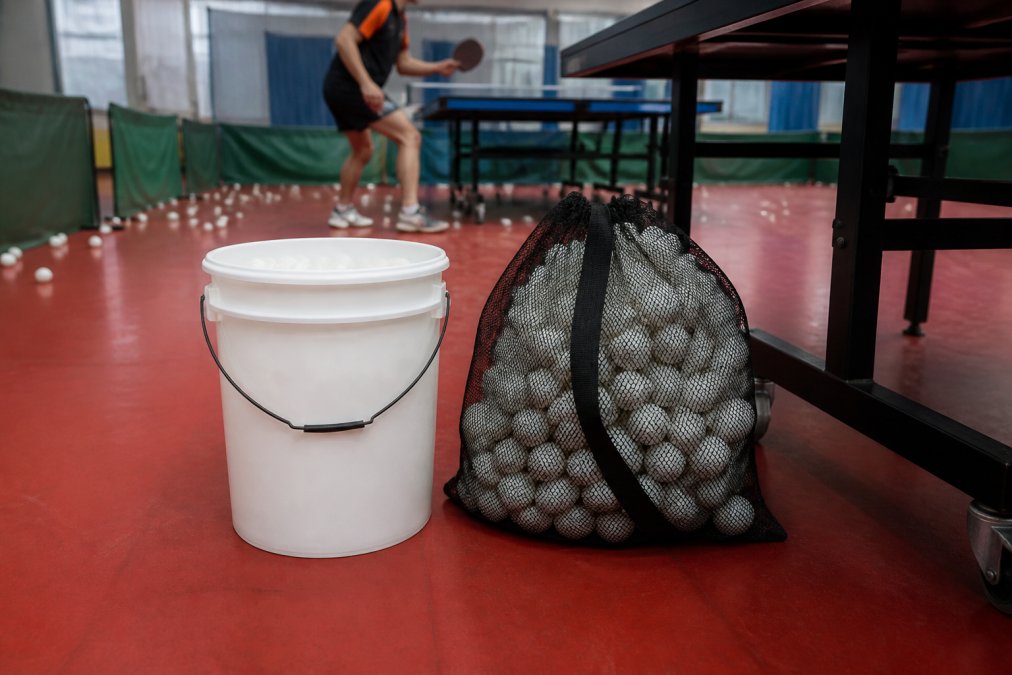
Proper ball collection eliminates repetitive bending, critical for players with back pain. MyPingPongBuddy's handmade ball collector breaks down in half for transport. The design is simple: scoop balls with minimal bending, collect efficiently, move to the next drill. MyPingPongBuddy helps save valuable time during cleanup.
The real value is sustainability. If you can train for two hours without aggravating your back, you build consistency that translates to improvement. Over a year, 15 extra minutes per week becomes 2,600 minutes annually, nearly 44 hours of additional training (peer-reviewed research).
Table Tennis Ball Collector Reviews and Comparisons
When evaluating ball collection systems, consider portability, durability, capacity, and ease of use.
MyPingPongBuddy stands out because it combines portability with durability. The handmade construction withstands daily use. It breaks in half, fitting easily into a gym bag. The 90-day full refund policy removes risk.
MyPingPongBuddy's design offers an ergonomic scoop angle and handle length optimized for common practice scenarios. The handmade quality means it lasts years.
| Feature | MyPingPongBuddy | Traditional Net Scoops | DIY Solutions |
|---|---|---|---|
| Portability | Breaks in half for easy transport | Bulky, hard to store | Varies widely |
| Durability | Handmade, built to last | Often break within 1-2 years | Unpredictable |
| Ease of Use | Ergonomic scoop angle | Requires more bending | Often awkward |
| Return Policy | 90-day full refund | Typically 30 days or none | No guarantee |
| Best For | All skill levels, especially back pain sufferers | Basic casual use | Budget-conscious players |
Table Tennis Footwork Training Equipment for Solo Practice
Footwork separates competitive players from recreational ones. Most beginners have decent strokes but terrible positioning. They reach for the ball instead of moving to it.
Solo footwork training requires specific equipment. A rebound board teaches you to reset after each shot, moving back to ready position instead of staying planted. A table tennis robot with adjustable spin and placement teaches you to move toward the ball's landing zone before it bounces, developing the anticipation that separates good players from great ones.
Footwork training builds cardiovascular fitness matching competitive play. A real match requires explosive movement and rapid direction changes. Solo drills with robots or rebound boards replicate this intensity. Players who do this work consistently tire less during matches and maintain technique under fatigue.
Space-Saving Training Solutions for Home and Club Environments
Not every player has a dedicated training facility. Space constraints shouldn't limit training quality.
MyPingPongBuddy's half-size breakdown stores in a corner or closet without dominating space. This portability improves equipment usage; when tools are easy to access, people use them more consistently.
For home players, a rebound board mounts on the table and folds away when not in use. A compact ball machine fits under a table. Even a small garage space can accommodate serious training equipment. The key is choosing tools with minimal footprint.
Club managers benefit from portable equipment that moves between tables easily. A ball machine taking 30 seconds to set up versus 5 minutes changes how often it gets used. Storage solutions matter too: wall-mounted racks for balls and paddles keep clutter off the floor.
Choosing the Right Training Aids for Your Skill Level
Equipment that accelerates a beginner's progress may bore an advanced player. The wrong tool at the wrong stage wastes money and creates frustration. Match your current ability to equipment that drives measurable improvement.
Beginner (0-6 months of regular play)
Beginners need tools that build foundational consistency without overwhelming complexity. Your priority is stroke repetition and basic footwork patterns.
Essential equipment:
- Rebound board: Teaches you to reset to ready position after each shot, addressing the most common beginner flaw. Expect 20-30 minutes per session on rebound drills.
- Ball collection system: At this stage, you'll hit 150-250 balls per session. Efficient collection reduces cleanup from 15 minutes to 5 minutes, giving you 10 extra minutes of drilling per session.
- Quality balls and paddle: Cheap balls have inconsistent bounce and teach bad habits. A mid-range paddle ($40-80) with consistent feel is far better than a budget option.
Avoid at this stage:
- Ball machines with spin variation. You'll struggle to read the spin.
- Sensor-based paddles or wearables. Focus on basic mechanics first.
Training volume target: 4-6 hours per week.
Intermediate (6-18 months of regular play)
Intermediate players have solid basic strokes and footwork. Your bottleneck is consistency under pressure and handling varied spin/speed.
Essential equipment:
- Ball machine with adjustable spin and speed: Look for machines offering at least three spin settings (topspin, backspin, sidespin) and variable speed (30-80 mph). Machines in the $800-2,000 range offer the precision you need. Expect 30-45 minutes per session drilling against specific spin types.
- Rebound board (advanced drills): Use it for reaction speed and multi-directional footwork. Pair it with a robot feeding balls to different court positions.
- Ball collection system: Your training volume increases to 300-400 balls per session.
- Motion-tracking app or smartwatch: Apps like Blast Motion track paddle acceleration, swing speed, and consistency metrics. A basic smartwatch ($150-300) logs heart rate during drills, helping you understand the cardiovascular demands of competitive play.
Specific drill-to-equipment pairing:
- For backhand loop consistency: Robot set to topspin at 60 mph, placed to your backhand side. Drill 50 consecutive loops. Track your success rate and consistency. A smartwatch logs your heart rate; competitive rallies typically spike to 140-160 bpm.
- For forehand attack against backspin: Robot set to backspin at 50 mph. Drill 40 consecutive attacks. Measure your attack success rate.
Avoid at this stage:
- High-end robots with AI-based adaptive play.
- Expensive sensor paddles ($300+).
Training volume target: 8-12 hours per week.
Advanced (18+ months of regular competitive play)
Advanced players have strong fundamentals and compete regularly. Equipment serves a diagnostic and refinement purpose.
Essential equipment:
- High-end ball machine with AI or adaptive features: Machines like the Newgy Roboplus ($2,000-4,000) offer placement precision, spin variation, and the ability to simulate specific opponent patterns. Some models integrate with video analysis software.
- Sensor-based paddle or wearable motion-tracking system: Sensor paddles track spin rate, impact location, and paddle angle. Wearables measure swing mechanics at a granular level. Investment: $400-800 for a complete system.
- Video analysis software: Software like Dartfish or Kinovea ($100-300/year) lets you overlay your swing mechanics against a reference model. This is where advanced players identify micro-adjustments that improve consistency by 5-10%.
- Ball collection system: You're drilling 400-600 balls per session.
Specific drill-to-equipment pairing:
- For serve variation under match conditions: Robot set to return your serve at varying speeds and spins. Drill 100 serves followed by third-shot attacks. Sensor data tracks your serve spin rate and consistency.
- For rally endurance: Robot set to multi-ball mode at match-level intensity (70+ mph). Drill for 5-10 minute rallies. Smartwatch logs heart rate; advanced players train to maintain technique at 160+ bpm.
Training volume target: 12-20 hours per week.
Budget Considerations Across Skill Levels
Beginner budget: $150-300 total (rebound board $40-60, ball collector pricing depends on quantity, dates, and delivery, quality balls and paddle $60-160).
Intermediate budget: $1,000-2,500 total (ball machine $800-1,500, rebound board $60, ball collector pricing depends on quantity, dates, and delivery, wearables/motion tracking $200-400, balls and supplies $100).
Advanced budget: $2,500-5,000+ total (high-end robot $2,000-4,000, sensor paddle or motion-tracking system $400-800, video analysis software $100-300/year, balls and supplies $200).
Invest in equipment that directly addresses your current bottleneck, not equipment that sounds impressive. A beginner with a $3,000 robot will see minimal improvement. An advanced player with only a rebound board will plateau.
Conclusion
Professional table tennis training aids transform how you practice. They eliminate wasted time on inefficient cleanup, build specific skills systematically, and make solo training as valuable as partner drills. Start with a quality ball collection system and a rebound board. Add a robot as you advance and identify specific weaknesses. Build your toolkit deliberately, based on your skill level and training goals.
Frequently Asked Questions
What are the best table tennis training aids for beginners?
Beginners benefit most from training aids that build stroke consistency and footwork coordination without overwhelming complexity. A quality ball collection tool improves practice efficiency by reducing cleanup time, while footwork training equipment like cones or agility ladders develops movement patterns essential for competitive play. Start with basics: a reliable ball collector, grip tape for racket control, and footwork markers before investing in advanced tools like robots or smart paddles.
How can professional table tennis training aids improve my serve practice?
Serve practice drills become more effective when you can focus on technique rather than ball retrieval. Professional training aids like ball collection nets and organized ball holders reduce downtime between repetitions, allowing you to complete more serves per session. Footwork training equipment helps you develop consistent stance and movement patterns, which directly impact serve placement accuracy and spin control during actual matches.
Are space-saving table tennis training aids effective for home practice?
Yes, space-saving designs don't sacrifice functionality. Portable equipment that breaks down for storage, like collapsible ball collectors and compact footwork training tools, allows serious players to maintain training intensity in limited areas. The key is choosing equipment with adjustable features that adapt to your available space while still supporting your stroke consistency and reaction speed development goals.
How do I know if professional training aids are worth the investment?
Professional-grade training aids deliver value through durability, design efficiency, and time savings. If you train multiple times weekly or run a facility, quality ball collection equipment and footwork training tools pay for themselves by reducing cleanup time and improving training focus. Look for handmade or premium construction, warranty coverage, and real customer testimonials from coaches or facility owners who use the equipment daily at volume.
MyPingPongBuddy's handmade ball collector removes the biggest friction point in training, cleanup. By eliminating repetitive bending and saving 15+ minutes per session, it lets you focus on actual skill development. The portable, durable design breaks down in half for easy transport, and the 90-day full refund policy means you can try it risk-free. Get started with MyPingPongBuddy and reclaim the training time you're currently losing to inefficient ball collection.